Let me begin by explaining how and why Satan is called "Lucifer".
Now as for the name” Lucifer”. The Old Testament Hebrew says Heylel “הֵילֵל”, which can mean “shining one”, but also means “boastful one” since this word comes from the root word “halel” הָלַל, which means to shine, to make a show, to boast, and thus, be foolish.
And judging by the boastful rant that this “shining one” gives in Is. 14:13-14, it’s no wonder why he’s a “boastful one”. Now the Greek Septuagint translates 'Heylel' to Heosphoros ἑωσφόρος, meaning 'bringer of dawn'. Heosphoros is a variant name of Eosphorus (Greek Ἐωσφόρος, "bearer of dawn"), which in turn comes from Phosphorus (Ancient Greek: Φωσφόρος, "bearer of light"). Both these names are said to be the personification of the “Morning Star” in Greek Mythology. This is NOT to say that these names are from Greek Mythology, but merely that these names are considered the personification of the “Morning Star”. Both Heosphoros and Lucifer are proper names within the Greek and Latin language. Because Heosphoros is a name, the Latin Vulgate translated it to “Lucifer”, meaning “shining one, morning star, bringer of light”. Therefore, it’s perfectly acceptable to view Lucifer or “Shining one” as a name.
Now, “Morning Star” is also a divine title given to Jesus Christ in 2 Pet. 1:19 “φωσφόρος” (Phosphoros-morning star), and in Rev. 22:16 “ἀστὴρ ὁ λαμπρὸς καὶ ὀρθρινός” (Bright and Morning Star).
Lucifer (Greek Heosphoros-morning star, Hebrew Heylel- shining one), the son of the morning, was meant to be a type of Christ (just as all Christians are to imitate Christ), but failed because of his pride.
Now, the real issue is the meaning behind Heylel and Heosphoros. Both of which refer to the morning star, especially with it’s complimentary line “son of the morning”. The phrase that’s used to describe Jesus as morning star is completely different from the phrase that’s used to describe Satan as a morning star. And yet because these different phrases mean the same thing, this is why Lucifer was a type of Christ. Much like when Scripture says “sons of God” and “Son of God”, “spirit” and “Spirit”, “son of man” and “Son of Man”, “morning stars” and “Bright and Morning Star”. One is referring to angels or men, while the other is a divine title reserved only to God. This is why Jesus is the true Day Star.
If you're still confused over why Jesus and Lucifer are both called "morning star", then let me explain further:
The angels of God are called sons of God because they are created spirit beings meant to serve God. We Christians are called sons and daughters of God because we are sinners adopted into God’s Family through the Redemption found in Christ Jesus. Yet, there is only one true Son of God, Jesus Christ, because only he is the Eternal Son who eternally proceeds from the Father, meaning only Jesus came directly from the Father, uncreated and eternally existing with Him from all Eternity.
It’s the same then when talking about “morning star”. Lucifer is referred as a “morning star” in Isaiah 14:12. And even all the angels of God are referred to “morning stars” in Job 38:7. And yet, just like there is only one morning star (Venus) in the night sky, so there is only one true Morning Star, Jesus Christ.
While Lucifer and the angels of God are referred as “morning star(s)” in the sense that they are spirits of light reflecting the glory of God, Jesus is the Bright and Morning Star in the sense that He is the source of eternal Light and Life, for only He is the very Glory of God.
Plus, when Lucifer is referred as “morning star” the Greek word that is used is “heōsphoros” (ἑωσφόρος), which means “dawn-bringer” referring to the morning star.
However, when Jesus is referred to as the “Morning Star”, Rev. 22:16 has a far different Greek phrase used to describe Him, and that is “ho astēr ho lampros kai orthrinos”(ὁ ἀστὴρ ὁ λαμπρὸς καὶ ὀρθρινός). The Bright and Morning Star! Literally, the Star of the Bright and Morning (a descriptive phrase always only referring to Venus, the morning star). Hence, Jesus and Lucifer is not the same “morning star”, they are totally different from each other.
Let me show you the differences between Satan and Jesus by first looking at their titles each one has, and then revealing their meaning, and finally how they were translated down through time.
Let’s start with Satan in Is. 14: 21 “O Lucifer” (KJV)
Hebrew “heylel” (הֵילֵל) = shining one, boastful one
Hebrew was translated into Greek as:
Greek “heosphoros” (ἑωσφόρος) = bringer of dawn, personification of morning star
Greek was translated into Latin as:
Latin “lucifer” = shining one, morning star, bringer of light
Latin was translated to English as:
English “Lucifer” (KJV)
Greek and Hebrew was translated to English as:
English “Day Star” (ESV), “morning star” (NIV), “star of the morning” (NASB), “shining one” (NET)
Now let’s look at Jesus in 2 Pet. 1:19 “morning star”
Greek “phōsphoros” (φωσφόρος” = bearer of light, personification of morning star
Greek was translated into English as:
English “day star” (KJV), “morning star” (NKJV)
And the Greek phrase “astēr o lampros kai orthrinos” (ἀστὴρ ὁ λαμπρὸς καὶ ὀρθρινός) in Rev. 22:16 was translated as "the Bright and Morning Star"
Notice that in the original languages (Hebrew and Greek) both Satan and Jesus have very different titles. However, because of the very similar meanings of these titles, English translations have sometimes used the same words to describe both Satan and Jesus as “morning star”. For example, notice how “heosphoros” (Satan) and “phosphoros” (Jesus) are both personifications of the morning star. Yet, “heosphoros” is the bringer of dawn, while “phosphoros” is the bearer of light. Simply put, Jesus the Bearer or Source of light is superior to Lucifer who merely brings the light. Just as the angels (i.e. messengers) bring the commands and decrees of God, so Satan was once the Bringer of the light of God. But Satan was never the Bearer or Source of the light of God. Keep in mind that angels merely reflect the light of God, while Jesus Himself is the Light.
Think of it like this: Jesus is the Sun who shines on the world during the day, while the angels are the Moon reflecting/bringing the light of the Sun during the night. That is what Lucifer used to be, but not anymore.
Sunday, June 7, 2015

Thursday, March 5, 2015
Mariolatry (Pt. 8) Mary our Advocate?
Is Mary really our Advocate?
NO!
Biblical Evidence against Mary as Advocate
Both the beliefs that we as Christians should pray and
petition Mary who will then offer them up to Jesus and that she intercedes for
us, turning God’s wrath away from us, are utterly unbiblical. Not only do we
not find a single biblical example of a believer offering prayers and petitions
to Mary in heaven, but nowhere in Scripture are we even encouraged to do so.
1 John 2:1 reveals
to us that we can go to Jesus as our Advocate who secures our right
relationship with the Father, stating, “My
little children, these things I write to you, so that you may not sin. And if
anyone sins, we have an Advocate with
the Father, Jesus Christ the righteous.”
In Hebrews 10:19-20,
we read, “Therefore, brethren, since we
have confidence to enter the
sanctuary by the blood of Jesus, by the new and living way which He opened for us through the curtain,
that is, through His flesh”. It’s
through the flesh of Jesus Christ I even have access and confidence to enter
God’s sanctuary in Heaven, not Mary. You don’t ever need Mary or anyone else
since it’s always Jesus Christ alone that we need. As a Christian one must
never put anyone between us and Jesus Christ since we can directly to Him through His blood and sacrifice for
our entrance into God’s sanctuary.
In John 14:14 Jesus Christ says, “If you ask Me anything in
My name, I will do it.” Thus, it’s
obvious that we don’t need to pray to anyone else who will then give our
petition to God.
In Roman Catholic theology, Catholics are taught that Jesus
is the King of Justice and Mary is the Queen of Mercy. Therefore, when
Catholics fear God’s justice they are taught to pray to Mary who then pleads
mercy for them before God.
But on the contrary, Philippians
4:6 says, “Have no anxiety about
anything, but in everything by prayer and supplication with thanksgiving let your requests be made known to God.”
(RSVCE)
Now, concerning the false belief that Mary appeases God’s
wrath and anger for believers, this is not found anywhere in Scripture as well.
1 John 2:2 says that Jesus “is the propitiation for our sins”. (see
also 1 John 1:10; Heb. 2:17). The
word “Propitiation” in the original Greek is, hilasmos, and can mean ‘expiation’, that is, the canceling/wiping
away of the penalty of sins, or it can mean ‘propitiation’, that is, a
turning away of God’s wrath by an acceptable offering.
In this specific verse the word ‘hilasmos’ does mean
propitiation, and plenty of examples in the Septuagint (Greek Old Testament)
can be cited in which ‘hilasmos’ is used in a propitiatory view (Gen. 32:20;
Num. 16:47-48, 25:11; 1 Sam. 26:19; 2 Sam. 21:3-4; 24:25; Prov. 16:14). Also,
John many times points out the theme of God’s wrath and Jesus being the
solution (John 3:16; 36; 8:24; 1 John 3:14; 5:16). Therefore, the evidence tilts
in preference for Jesus turning away God’s wrath for us sinners, since His
continual heavenly intercession involves applying His death to our salvation.
Hence, we do NOT need Mary to turn away God’s wrath because it’s Jesus alone
who turns away God’s wrath from us through His perfect work.
Rome falsely asserts that Mary’s prayers “will deliver our
souls from death” (Catechism of the
Catholic Church {DoubleDay,, 1994], par. 966, p.274). For this reason Rome
believes Mary helps in “restoring supernatural life to souls” (CCC, par. 968). Presenting Mary as a
co-savior in this way is extremely insulting to us regenerated Christians who
believe that Jesus alone delivers our souls from death and restores
supernatural life to souls. As the Apostle Paul proclaims in 1 Tim. 2:5-6, “For there is one God,
and one mediator also between God and men, the man Christ Jesus, who gave
Himself as a ransom for all, the testimony given at the proper time.”
If there is only one mediator between God and Mankind, i.e.
the Man Christ Jesus, why then do we need Mary as another mediator and raise
her up to such a superior and exalted level? Rome answers by saying, “There may be only one mediator between God
and men, and that’s Christ Jesus, but who is the mediator between man and
Christ Jesus”. Our response is, you
don’t need one. One goes directly to Jesus Christ to our Father in Heaven.
We are NOT to give our prayers in Mary’s name, who in turn will give those
prayers to Jesus Christ her son, who in turn will give them to God. Since
Christ Jesus is our ONE and only Mediator, there is thus only one way to come
near to God, for only Christ Jesus “gave Himself as a ransom for all, the
testimony given at the proper time”. 1
Thess. 5:9 declares, “For God did not appoint us to wrath, but to obtain salvation
through our Lord Jesus Christ”. Thus, salvation is through Christ, Not
Mary.
The Bible most plainly forbids communicating with dead. Deut. 18:10-11 states, “There shall not
be found among you anyone who makes his son or his daughter pass through
the fire, or one who practices witchcraft, or a soothsayer, or
one who interprets omens, or a sorcerer, or one who conjures spells, or a
medium, or a spiritist, or one who
calls up the dead,”. The word ‘spiritist’ that is used in Hebrew is darash (דָּרַשׁ). Old Testament Scholar, Earl S. Kalland
explains that the word is referring to, “(‘[one] who consults the dead’) is
one who investigates, looks into, and seeks information from the dead” (Earl S.
Kalland, Deutoronomy, ed. Frank E. Gaebelein, The Expositor’s Bible
Commentary with the New International Version, Volume 3, p. 121, n. 11). Sadly,
Catholics seek the deceased saints and Mary for help. Isaiah 8:19 reveals more of the Bible’s stance on communication
with the dead:
“And when they say to you, “Seek those who are mediums and wizards, who
whisper and mutter,” should not a
people seek their God? Should they seek the dead on behalf of the living?”
The Bible’s stance is that Christians must seek God on behalf of the
living. We are not to seek the dead, like the saints and Mary. Now, Catholic
apologists in predictable fashion will reply to this by misusing Matthew 22:32, which states, “God is
not the God of the dead, but of the living.” Romanists such as Patrick Madrid
make the flawed case that because the saints are alive in Heaven the Biblical
prohibitions against praying to the dead do not apply on them (Patrick Madrid, Answer
Me This!, [Our Sunday Visitor Publishing Division, 2003], p.168).
First, this verse was never meant to be an
argumentation that permits prayers to the dead saints in the New Testament
times. Nowhere does the context indicate such a thing. This out-of-place use of
the text is just not the case whatsoever. Second,
even though believer who enter Heaven are spiritually alive with God, they are
nonetheless dead as Scripture proclaims. Hence, communication with them is
prohibited. Joshua 1:2 states, “Moses
My servant is dead”. Furthermore,
in Acts 2:9, a follower of Christ named
Eutychus sat next to a window and as he fell asleep, “he fell down from the
third story and was taken up dead”.
So according to Scripture, even though the dead saints are living spiritually,
they are nonetheless counted as part of the dead, and thus, communicating with
them is prohibited.
In spite of the fact that later church fathers began communicating with
the dead saints and Mary, Early Church history showed no such thing. The
Historian Philip Schaff writes:
“In the first three centuries the veneration of the martyrs in general restricted itself to the thankful remembrance of the their virtues and the celebration of the day of their death as the day of their heavenly birth...But in the Nicene age it advanced to a formal invocation of the saints as our patrons (patroni) and intercessors (mediators), before the throne of grace, and degenerated into a refined form of polytheism and idolatry. The saints came into the place of the demigods, Penates and Lares, the patrons of the domestic hearth and country” (Philip Schaff, History of the Christian Church, volume 3, [Hendrickson, 2011], p. 432)
Since the dead saints are with God in Heaven, this means that they are
in a condition of perfect happiness or absolute peace. Revelation 21:4 recounts those in Heaven as never experiencing
sorrow, nor crying, nor pain. However, if the saints in Heaven were presented
with all the prayers from all the Catholics in the world in regards to all
their troubles, trials, adversities, afflictions, maladies, etc. they would
definitely be full of grief and in great pain. Therefore, it is impossible that
the saints and Mary receive those prayers and intercede for them.
Historical
Evidence against Mary as Advocate
A meticulous examination of the Early Christians of the first 300 years
shows that it was never orthodox to seek Mary’s intercession through prayer.
Rather, for the first three centuries drew near to God through Christ and
prayed directly to them. When one reads their writings on prayer or anywhere
prayer is talked about in some length, not one reference is made about praying
to Mary or seeking her heavenly intercession. The mere fact that the disciples
of the Apostles and the following generations after them for the next three
centuries never participated in such a practice is damaging proof that the
Roman practice is false. Rather, we find proof to the contrary. For instance, in
Clement’s late 1st century letter to the Corinthians he states how Christians must
strive against, “unrighteousness and iniquity, along with all covetousness,
strife, evil practices, deceit, whispering, and evil-speaking, all hatred of
God, pride and haughtiness, vain glory and ambition. For they that do such
things are hateful to God” (Clement, Letter to the Corinthians, 35). He
understands the struggle of the Christian life. Therefore, instead of
encouraging his readers to pray to Mary for help and strength as Modern
Romanism teaches, Clement urges them to pray to Jesus in their time of need and
temptation:
“This is the way, beloved, in which we find our Savior, even Jesus Christ, the High Priest of all our offerings, the defender and helper of our infirmity. By Him we look up to the heights of heaven” (Clement, Letter to the Corinthians, 36).
Now there is possibly one exception of prayer offered to Mary before
the 4th century of Christian history. This prayer that some date to
about 250 A.D. is named the ‘Sub-tomb Presidium’ which invokes Mary asking for
her protection from persecution and worldly hazards. However, the Historian
Maxwell Johnson mentions that lots of scholars are reluctant to give this
prayer an early date and instead choose to give it a later date (Maxwell E.
Johnson, Praying and Believing in Early Christianity, [Liturgical Press,
2013], p. 79). Yet, even if it’s given a later date, Johnson comments:
“It remains the earliest marian prayer in existence” (Maxwell E. Johnson, Praying and Believing in Early Christianity, [Liturgical Press, 2013], p. 90).
So it’s not until around 250 A.D. or later that one finally sees a
prayer to Mary in Christian history. Then, more than 100 years passes before
the first Christian Father is recorded to have prayed to Mary. As Church
Historian Philip Schaff states:
“The first instance of the formal invocation of Mary occurs in the prayers of Ephraim Syrus (379), addressed to Mary and the saints” (Philip Schaff, History of the Christian Church, volume 3, [Hendrickson, 2011], p. 422).
Later on, others take part in this new but unorthodox practice, like Gregory
of Nazianzus and Epiphanius of Salamis. Then, it gradually becomes the
prevalent practice on account of these influences. Remarking on this
development, J.N.D. Kelly affirms:
“Devotion to the Blessed Virgin developed more slowly…Thus reliable evidence of prayers being addressed to her, or of her protection and help being sought, is almost (though not entirely) non-existent in the first four centuries” (J. N. D. Kelly, Early Christian Doctrines, [HarperOne, 1978], p.491).
As concerning Mary being invoked to turn away God’s wrath from Catholics,
which is the other-half of the Roman teaching, this belief develops later in
Church history. Medieval piety is what caused modern Catholics to believe this.
Elizabeth Johnson discusses this particular popular medieval legend called the Apocryphal
Theophilus Legend, based on the 6th century cleric Theophilus of Adana, stating:
“The idea that Mary had maternal influence over God, that she could turn away Christ’s just anger and obtain mercy for sinners, had already been accepted in the East, as seen in the popularity of the Theophilus Legend. In this story a man bargains his soul away to the devil to gain a lucrative job. Near death he implored Mary to get back the contract, which she does after contending with the devil. Theophilus dies forgiven and avoids eternal hell. Translated into Latin in the eighth century, this story exercised great influence on the West’s notion of Mary’s power to save” (Elizabeth Johnson, “Blessed Virgin Mary,” ed. Richard P. McBrien, The HarperCollins Encyclopedia of Catholicism, [HarperCollins Publishers, Inc., 1995], p.833)
This fictitious tale was then utilized by well-known western churchmen
like Bernard of Clairvaux (1090-1153 A.D.), Bonaventure (1221-1274 A.D.), and
Alphonsus Maria de' Liguori (1696-1787 A.D.), to advance the belief that Mary
could turn away God’s anger by asking her in prayer. Therefore, it is mostly on
account of this ridiculously fabricated 6th century tale, which came
into Latin Christendom in the 8th century, that Modern-day Catholics
believe this teaching to this day. Germanus I of Constantinople who died in 733
A.D. popularized this belief as well that Mary could turn away God’s wrath from
Catholics (Richard P. McBrien, Catholicism: New Edition, [HarperOne,
1994], p. 1085).
We see once more that this teaching is unbiblical and ahistorical.
Saturday, February 28, 2015
Mariolatry (Pt. 7) Mary the Mediatrix of all Graces?
Is Mary really the Mediatrix of all Graces?
NO!
Biblical Evidence against Mary as Mediatrix of all Graces
First, let’s start with the Biblical
evidence against Mary being the Mediatrix of all Graces.
Because the average life-expectancy
of the 1st century society in relation to the New Testament was
probably around 20-25 years, it’s fairly reasonable to conclude that Mary died
before most of the later New Testament books were written. With this in mind,
it’s fascinating to observe that when these New Testament books talk about the
subject of the application of heavenly Grace, they invariably declare that it
comes from God, never Mary. For instance, Scholars date the Book of Revelation
after 66 A.D. In fact, most of these later New Testament books are around 90 to
95 A.D. Now, if Rome is correct that Mary should have been applying grace to
all men around this time, the fact remains that Revelation 1:4 states that
grace is given by God, not Mary.
“Grace to you and peace from
Him who is and who was and who is to come” (Rev. 1:4)
Furthermore, the Second letter of
John was at some point written after 80 A.D. And this Epistle also attests to the
fact that Grace comes from God the Father and Jesus Christ, not Mary.
“Grace, mercy and peace
will be with us, from God the Father and from Jesus Christ, the Son of the
Father, in truth and love.” (2 John 1:3)
Moreover, Scripture says that there is only One Mediator.
“For there is one God and one Mediator between God
and men, the Man Christ Jesus” (1 Tim.
2:5)
Catholics will object to this, saying that just because the
verse says “One Mediator”, doesn’t mean that no one else can participate in the
mediation. So there are lesser mediators such as Mary and the saints
participating in mediation.
Well let’s allow this logic and apply it not just to the
“One Mediator”, but to the “One God”. By the Catholics logic, we can say that
just because there’s “One God”, doesn’t mean that no one else can participate
in Deity. Therefore, there are lesser
gods participating in God’s deity.
You see how the Catholic’s logic fails. Scripture plainly and emphatically tells us that there is only one true
God (Deut. 4:39; 6:4) And Scripture
plainly and emphatically tells us there is only
one true Mediator, and there is no other.
Similarly, Acts 4:12 declares, “Nor is there salvation in any other, for there
is no other name under heaven given among men by which we must be saved.” There
is only one name and there is only one Mediator, and that is Jesus Christ. Yet,
the Catholic Church blasphemously proposes another mediator.
One must understand that the reason why Jesus is our only
Mediator is because He has a basis upon which to mediate, and that basis for
mediation is that He shed His blood on our behalf. Thus, when Jesus mediates
for us He has a basis upon which He intercedes for us, and that is what He did
on the Cross. Jesus Christ is our only Mediator because He alone died and made
restitution for our sins. He died as our perfect substitute. He bore our sins
in His body upon the tree. Mary and the saints have absolutely no basis upon
which to mediate. Mary did not bear my sins in her body. And even the Catholics
admit that everything that Mary and the saints have they have from Christ.
Therefore, since they cannot be mediators in the sense that Christ is, they
cannot participate in Christ’s one mediation, and thus, they cannot mediate for
us.
Hence, Mary is NOT the Mediatrix of all Graces.
As a further matter, in order for
Mary to be capable of applying grace to billions of believers across the world
at the same time, without interruption until the end of the world, as Vatican
II claimed, she would need to be capable of being in various places simultaneously.
Only an omnipresent being can be present everywhere at the same time. Yet, only
God has the divine attribute of Omnipresence (1 King 8:27). Mary would also
have to know who to give grace to, which means that she would have to be
omniscient. Yet, only God has the divine attribute of Omniscience as well (1
John 3:20). Mary would also need to be powerful enough to apply grace to all
believers across the earth simultaneously. And yet, only God has the divine
attribute of Omnipotence (Job 42:2).
By declaring Mary as the Mediatrix
of all Graces, Catholics end up ascribing to Mary divine attributes that God
alone possesses and that serves to glorify God alone.
It should also be noted that in Catholic theology there is
this principle idea that Mary is close to Jesus because she’s the ark, the
vessel that gave birth to Him. It’s because of this concept that Catholics are
taught to pray to Mary because she can speak to Christ for us, since she is His
mother, and thus, is closer to Him than we are. This Catholic notion is
completely false because Jesus Himself said in Matt. 12:48-50 that those who do the will of the Father are His
brother, sister, and mother to Him. Therefore, Mary is no closer to Jesus than
we are by the Blood shed for us on the Cross.
Our Lord Jesus Christ said in Matt. 11:28, “Come to Me,
all you who labor and are heavy laden, and I will give you rest.”
And the Apostle Paul teaches us in Heb. 7:25 that Jesus “is also able to save to the uttermost those who come to God through Him, since He always lives to make intercession for
them”
And in Rom. 10:13
we are taught that “whosoever shall call upon the name of the Lord shall be
saved”
Hence, Scripture teaches us that we can go directly to Jesus
Christ since He is our ONE and ONLY Mediator. This is the very reason why Jesus
came into this world, to save all of us from our sins and give us Eternal Life
through Him alone. There is ABSOLUTELY NOTHING in Scripture that talk of a
Co-Mediatrix of all Graces with Jesus. There are no two mediators. Just ONE!
And there is no need for another mediator. Scripture clearly does NOT teach nor
has it EVER taught that we somehow need to come to the Father through Jesus via
Mary.
Historical Evidence against Mary as Mediatrix of all Graces
Now, we look at the historical evidence that Mary is NOT
the Mediatrix of all Graces.
In analyzing the disciples of the
Apostles, the Apostolic Fathers, we find no indication that they thought Mary
applies all graces to humanity from heaven. It’s the same situation when we
look at the 2nd century apologists as well as later generations of
Church Fathers. According the HarperCollins Encyclopedia of Catholocism,
this doctrine is first found in the “late
medieval era”. Catholic Scholar Ludwig
Ott acknowledges that “Express
testimonies, though few in number, to Mary’s position as mediatrix of grace are
found since the eighth century” (Fundamentals of Catholic Dogma, p. 214).
As stated by Ott, it’s not until about 700 years after Christ’s death that people
begin to assert that Mary is mediatrix of all graces. Even the Patristic
Scholar, J.N.D. Kelly, agrees that “centuries had to elapse before the
doctrines of...her position as intercessor and mediator...could become elements
in the day-to-day faith of Catholic Christians” (Early Christian Doctrines, p.
499).
Not only did none of the Patristic
Fathers bear witness to this doctrine, proving that the Apostles never passed
on this teaching to the Church for all to believe in, but many Patristic
Fathers have testified to holding beliefs contrary to this teaching. These
Fathers clearly taught that it’s God that gives grace to men, not Mary.
For instance, Clement of Alexandria stated, “For
it were truly monstrous that that which is not complete should be called a gift
(or act) of God’s grace. Being
perfect, He consequently bestows
perfect gifts.As at his command all things were made, so on His bare wishing to
bestow grace, ensures the perfecting
of His grace” (The
Paedagogus, Book I, 6).
Likewise, John Chrysostum said, “For
the whole is of God who wills to bestow
upon many, so that the grace may
appear the greater” (Homily 9 on 2
Corinthians)
Moreover, Jerome declared, “It Has been
established that the Lord, by the same
grace wherewith He bestowed upon us free choice, assists and supports us in our individual actions” (Against
the Pelagians, Book III, 6)
In John’s Gospel Chapter 17 our Lord
Jesus Christ proclaims, “And this is
eternal life, that they may know You, the only true God, and Jesus Christ whom
You have sent.” (John 17:3). This statement sums up
everything we need to know for our eternal salvation and eternal life. To know
our Lord Jesus Christ is to know the only true God. Hence, there is no need of
Mary for eternal life since our Lord Jesus himself never mentions her anywhere
in Scripture concerning eternal life.
Discussing on the medieval Roman misuse of Luke 1:28
in order to support this false doctrine, Church Historian, Alister Mcgrath, said it was disproven by the Catholic Scholar Erasmus saying, “According to the
Vulgate, the angel Gabriel greeted Mary as ‘the one who is full of grace’ (gratia plena) (Luke 1:28), thus
suggesting the image of a reservoir full of grace, which could be drawn upon at
a time of need. But as Erasmus pointed out, the Greek simply meant ‘favored
one,’ or ‘one who has found favor’. Mary was one who had found God’s favor, not
necessarily one who could bestow it on others. Once more, an important feature
of medieval theology seemed to be contradicted by humanist New Testament
scholarship” (Historical Theology: An Introduction to the History of Christian
Thought, p. 97)
Thursday, February 26, 2015
Mariolatry (Pt. 6) Praying to Mary as a Mediator and Helper?
Should we pray to Mary as our Helper and Mediator?
No!
First, Prayer is a form of worship that is reserved to our
Triune God alone. As Jesus said to Satan in Matt. 4:10, “It is written, 'You shall worship the LORD your God,
and Him only you shall serve.'”
Second, In Matt. 6:9,
when Jesus taught his disciples to pray He said “In this manner, therefore,
pray: ‘Our Father in heaven,
Hallowed be Your name’”. Also, the Apostle Paul taught us in Phil. 4:6 who it is that we should pray
to, saying, “Be anxious for nothing, but in everything by prayer and
supplication, with thanksgiving, let your requests be made known to God”. And even James the brother of Jesus said
in James 4:8, “Draw near to God and
He will draw near to you.”
Therefore, No prayer is ever directed to Mary nor should it
ever. The Catholic would have you believe that we should cast our cares and
petitions to Mary, but Scripture is quite clear that we Christians should pray
ONLY to Jesus, “casting ALL your
care upon Him, for He cares for you.” (1
Pet. 5:7)
Now some Catholics might object saying, “We don’t pray to
Mary, we ask Mary to pray for us, just like you would ask your family or
friends to pray for you, because Mary has direct access to Jesus and can see
Him face to face”
There are two problems to this statement.
1. The Bible says “Let us then approach God’s throne of
grace with confidence, so
that we may receive mercy and find grace to help us in our time of need.” (Heb. 4:16; NIV). The Bible also tells us that it’s because of Jesus that we
may approach God. As Eph. 3:12
proclaims, it’s “in whom [Jesus] we have boldness and access with confidence
through faith in Him.” (NKJV). “So
we can confidently say, ‘The Lord is MY HELPER; I will not fear; what can man
do to me?’” (Heb. 13:6, ESV)
Believers in Christ can approach the throne of grace with
confidence. Therefore, true believers have direct access to God Himself, which
was signified at Christ’s death on the Cross when the veil in God’s Temple was
ripped top to bottom, showing that all believers can now pray to God directly.
There is no need for Mary or the saints to give you access to Jesus, since all
those saved by Christ through faith can now enter into direct fellowship with
God.
2. When a Catholic claims that they can pray to Mary or ask
Mary to pray for you, he or she is assuming that Mary has the divine attributes
of Omnipotence and Omnipresence which only God alone has. It is ridiculous to
claim that Mary can answer prayers or pray for those asking her to pray for
them, when millions of Catholics cry out to her at the same time, which would
assume that Mary, a mere human being, is to a certain degree omnipotent and
omnipresent. This is blasphemy. Mary is not our Mediator nor can she ever be
our Mediator.
Now another Catholic might object saying, “Well, we don’t
worship Mary, we venerate her.”
My response would be that, “the bigger issue is, how is it
you venerate her in practice. You see it doesn’t matter what you call it, what matters
is how it is in reality. Whether you call it worship or veneration, it’s all
just semantics. One could say “We don’t eat, we feast”, or “We don’t cry, we
weep” or “We don’t scream, we yell”. It’s all semantics, because in reality,
when one venerates, one is giving their devotion, their heart, their life to a
person who is no longer here on Earth.
For example look at these pictures of people venerating
Mary.
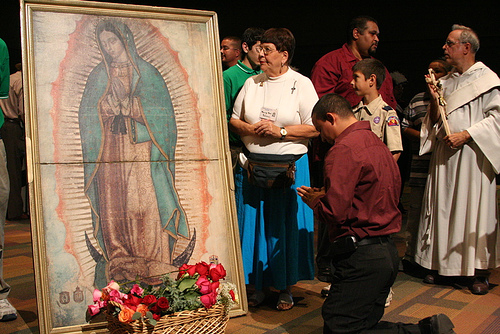


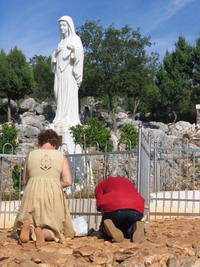
Looking at these pictures one realizes that no matter how
you put it, this is worship of an idol.
The Word of God in Exodus
20:3-4, says “You shall not make for yourself a carved image—any
likeness of anything that is in heaven above, or that is in the earth
beneath, or that is in the water under the earth; you shall not bow down to them nor serve them. For I, the
LORD your God, am a jealous God, visiting the iniquity of the fathers upon the
children to the third and fourth generations of those who hate Me” (NKJV)
Now we true Christians do respect greatly Mary, mother of
our Lord Jesus Christ, but not in a way that belongs to God alone. The Glory,
worship, honor, and praise belonging only to God, must be given to God alone
and to no one else, not even to Mary. Scripture tells us in 1 John 5:21, “Little children, keep
yourselves from idols. Amen.” (NKJV)
And in Deuteronomy
4:15-19, “Take careful heed to yourselves, for you saw no form when the
LORD spoke to you at Horeb out of the midst of the fire, lest you act corruptly
and make for yourselves a carved
image in the form of any figure: the
likeness of male or female, the
likeness of any animal that [is] on the earth or the likeness of any winged
bird that flies in the air, the likeness of anything that creeps on the ground
or the likeness of any fish that [is] in the water beneath the earth. And [take heed], lest you lift your eyes to
heaven, and [when] you see the sun, the moon, and the stars, all the host of
heaven, you feel driven to worship them and serve them, which the LORD your God
has given to all the peoples under the whole heaven as a heritage.”
The command is clear. One must not bow down to idols of any
kind including Marian statues.
And even scripture shows us that no one was to worship any
person whether human or angel. For example, in Acts 10:24-26, it says “And the following day they entered
Caesarea. Now Cornelius was waiting for them, and had called together his
relatives and close friends. As Peter
was coming in, Cornelius met
him and fell down at his feet and
worshiped him. But Peter lifted
him up, saying, "Stand up; I
myself am also a man.”
Also in Acts 14:11-15,
“Now when the people saw what Paul had done, they raised their voices, saying
in the Lycaonian language, "The
gods have come down to us in the likeness of men!" And Barnabas
they called Zeus, and Paul, Hermes, because he was the chief
speaker. Then the priest of Zeus, whose
temple was in front of their city, brought oxen and garlands to the gates, intending to sacrifice with the
multitudes. But when the
apostles Barnabas and Paul heard this, they tore their clothes and ran in among
the multitude, crying out and saying, "Men, why are you doing these things? We also are men with the same
nature as you, and preach to you that you should turn from these
useless things to the living God, who made the heaven, the earth, the sea, and
all things that are in them” (NKJV)
And in Revelation
19:9-10, “Then he (the angel) said to me, "Write: 'Blessed [are] those
who are called to the marriage supper of the Lamb!' " And he said to me,
"These are the true sayings of God."
And I fell at his feet to
worship him. But he said to me, "See that you do not do that! I am your fellow servant, and of your
brethren who have the testimony of Jesus. Worship God! ...” (NKJV)
Finally, Rev. 22:8-9,
“Now I, John, saw and heard these things. And when I heard and saw, I fell down to worship before the feet
of the angel who showed me these things. Then he said to me, "See that you do not do that. For I am
your fellow servant, and of your brethren the prophets, and of those
who keep the words of this book. Worship
God!" (NKJV)
As the Bible has shown, idolatry is a very serious matter
that no one is allowed to worship any other thing or person, except God
Himself.
Mediatrix of all Graces
There are two ways in which
Catholics call Mary the Mediatrix of all Graces.
The first meaning is that Mary gave birth to Jesus. And since Jesus
brings grace to all men, Mary can be said to be Mediatrix of all Graces. True
Christians aren’t really opposed to this first meaning, nonetheless we wouldn’t
use the term Mediatrix of all Graces.
The second meaning, however, is the one that causes Christians to rightly
worry. We read in The HarperCollins Encyclopedia of Catholicism that “through her
continual intercessions, Mary was seen as the dispensatrix (Latin) who distributed and applied the
graces of Christ” (“Mediatrix”, ed. Richard P. McBrien, [HarperCollins
Publishers, Inc., 1995], p.848).
Vatican II declared as fact that Mary is in Heaven supposedly continuously
distributing and applying grace to all mankind till the end of the world. As it
states, “This maternity of Mary in the order of grace began with the consent
which she gave in faith at the Annunciation and which she sustained without
wavering beneath the cross. This maternity will last without
interruption until the eternal fulfillment of all the elect. For taken up to
heaven, she did not lay aside this saving role, but by her manifold acts of
intercession continues to win for us gifts of eternal salvation. By her
maternal charity, Mary cares for the brethren of her Son... the Blessed Virgin is invoked by the Church under the titles of
Advocate, Auxiliatrix (Helper), Adjutrix (Benefactress), and Mediatrix.” (Lumen
Gentium, 62)
Catholic Theologian Ludwigg Ott explains
in his book, Fundamentals of Catholic Dogma, that “Since her assumption into
Heaven, Mary cooperates in the application of the grace of Redemption of man.
She participates in the distribution of grace” (p.213)
For this reason, Pope Pius VII proclaims Mary as the “Dispensatrix
of all graces” (Pius VII, Ampliatio privilegiorum ecclesiae B.M.
Virginis ab angelo salutatae in cenobio Fratrum Ordinis Servorum B.M.V. Florentiae,
A.D., 1806; Armand J. Robichaud, S.M., “Mary,
Dispensatrix of all Graces”, Maiology, II, p.429)
Advocate
The Vatican Church also teaches that
Catholics should pray to Mary and offer their needs and petitions to her, which
she supposedly brings to Jesus as maternal intercessor, and that Mary turns
away God’s anger and wrath for people. Catholic feminist theologian Elizabeth Johnson states that, “Mary
had a maternal influence over God, that she could turn away Christ’s just anger
and obtain mercy for sinners” (“Blessed
Virgin Mary”, ed. Richar P. McBrien, The
HarperCollins Encyclopedia of Catholicism, p.833)
Saint and Doctor of the Church, Alfonso de’Ligouri states in his book, The
Glories of Mary, “Be comforted then, O you who fear’ will I say with
Saint Thomas of Villanova; ‘breathe freely and take courage, O wretched
sinners; this great Virgin who Is the Mother of your God and Judge, is
also the Advocate of the whole human race: fits for this office, for
she can do whatever she wills with God, most wise, for she knows all the means of
appeasing Him” (Alphonsus
Liguori, The Glories of Mary, [Tucker
Printer Perry’s Place, 1852] p.161)
Pope Pius XI proclaimed “O Blessed Mother, our Queen and Advocate...gather together our prayers and we beseech you (our hearts one with yours) present them before God’s throne...that we may reach the portal of salvation” (Pius XI, papal allocation to French pilgrims present for reading of ‘de tuto’, Canonization of Antida Thouret, 15 August 1933, L’Osservatore Romano, August 15, 1993).
Furthermore, Pope Pius XII declared, “Our Advocate, placed between God and the
sinner, takes it upon herself to invoke clemency of the Judge so as to temper
His justice” (Pius XII, papal allocation
at the Canonization of Louis Marie Grignon de Monfort, 21 July 1947, AAS 39, 408).
Some Catholics believe that the
doctrine of Mary as Mediatrix of all graces is not official Catholic doctrine,
and thus, they do not have to accept or justify it. However, this doctrine is regarded
by the Vatican Church as part of the infallible teaching of the Ordinary
Universal Magisterium. In others words, since this doctrine has for a long time
been accepted and supported by Popes and by bishops united with them, it is
infallible for all Catholics because the Vatican claims the Church could not
have been in doctrinal error at such a high level within the Hierarchy for such
a long time.
On the subject of this doctrine,
Catholic Mariologist Mary Miravalle states
in her book, Introduction to Mary, that “in light of the fact that the
doctrine of Mary as Mediatrix of all graces has been universally taught in the
Church by popes of the last two hundred years and by the bishops in union with
them (ordinary Magisterium), and in virtue of this universal teaching of the
Church, it has been the opinion of certain modern Mariologists that the
doctrine of Mediatrix of all graces already possess the nature of a defined
doctrine of faith. In short, the Marian roles of Co-Redemptrix and Mediatrix of
all graces represent essential Catholic teaching through the order of the
ordinary Magisterium. This charism of the universal teaching authority of all
bishops who, when in union with the pope, can exercise the ecclesial element of
infallibilty, is disussed in Vatican II’s Constitution
on the Church (Lumen Gentium, No. 25).” (p.111)
Some Catholics believe that these teachings are not
official and therefore they do not have to believe them or defend them.
However, these teachings constitute what is known as infallible teaching of the Ordinary Universal Magisterium. That is
because these have been affirmed for so long by Popes and bishops in union with
them it is infallible for Catholics since according to Rome the Church could
not be in doctrinal error for so long in such a high level.
Monday, February 16, 2015
God's Creation, The Fall of Lucifer, and the Rise of the Messiah
This is a three-part video. The first is the Creation of the Universe by the Word of God, including the creation of the angels and the origin of Lucifer
The second is the Fall of Lucifer. While I do use Ezekiel 28:12-19 and Isaiah 14:12-15 to explain the fall of Lucifer, Lucifer's first speech is merely a construction that I myself made, which I based it upon certain verses of the Bible. I tried to be as faithful to the scriptures as possible when constructing what Lucifer might have said to God when wickedness was found in his heart. I also mention the fall of other angels who lusted after women and gave birth to the Nephilim.
Then, I move on to the third and final part, the rise of the Promised Messiah. I give several speeches, each one concerning every single name and title that is given to Jesus Christ.
Here is a google doc link to my narration speech with all the Bible verses used:
https://docs.google.com/document/d/14_qVEA9FV7bdIGQhB1mHI8wQnYStGFanYYYBEtg5Ghg/edit?usp=sharing
Almost 99% of my narration is taken straight from the Bible.
One thing I might regret is that the music sometimes overpowers my voice. Despite that, I believe you can still clearly make out what I'm saying.
I own none of the vids and music used in this video.
Thanks and Credit:
All Glory, Honor, and Praise goes to my Triune God, to the Father, Son, and Holy Spirit.
Archangelclk- for the concept to my vid and his "Love like fire" music vid
https://www.youtube.com/watch?v=av0OjugpMX8
http://www.youtube.com/watch?v=GUWkHUj4-PA
Roma Downey & Mark Burnett- For the Bible Series Extended Look trailer
http://www.youtube.com/watch?v=Wir4fH6hUxw
Sevenfold Films & Creation Science Evangelism- for both Genesis Series teaser trailers
http://www.youtube.com/watch?v=dbXUF9i47EU
www.genesisseries.com
Michaelegit- for the Creation of the world vid
http://www.youtube.com/watch?v=_RKByQf9jsk
Guy Tourgeman- for the earth zoom to universe vid
http://www.youtube.com/watch?v=5EanYhkv5P8
Blizzard Entertainment- for the Diablo 3 cinematic scenes
Konami & MercurySteam- for the Castlevania: Lords of Shadow 2 trailer
http://www.youtube.com/watch?v=sXyblWhsDys
Vigil Games and THQ- for the Darksiders 2 trailers & commercial
http://www.youtube.com/watch?v=FEw2oU2WH2w
http://www.youtube.com/watch?v=sJp6O53PiXE
http://www.youtube.com/watch?v=n2Uc-zmiS8o
Music:
The Audiomachine- The New Earth 0:00
Frozen Synapse OST- Deeper 3:06
Has Zimmer- Time 5:40
Audiomachine- Gaurdians at the Gate 8:52
Audiomachine- Epica 10:56
Two Steps From Hell- Love & Loss 15:39
Audiomachine- The Odyssey 17:28
Epic Score- Rightful Heir 20:51
Immediate Music- Serenata Immortale 23:17
Audiomachine- Reaching 26:56
God's blessings to you all, my Friends.
One Love, One Joy, One Peace = Jesus Christ
Monday, February 9, 2015
Mariolatry (Pt. 5) Mary the New Eve?
Is Mary the New Eve
from Gen. 3:15?
NO!
Pope Pius IX argued that Gen. 3:15 established the doctrine
of the Immaculate Conception. He said, “the most holy Virgin, united with him
[Christ] by a most intimate and indissoluble bond, was, with him and through
him, eternally at enmity with the evil serpent, and most completely triumphed
over him, and thus crushed his head with her immaculate foot” (Pope
Pius IX, Ineffabilis Deus, Interpreters of the Sacred Scripture,
italics and brackets mine).
It’s ‘He’, Not ‘She’
As has been already explained in a previous post, the “she”
and “her” in Gen. 3:15 of the Latin
Vulgate is a mistranslation. In the Douay Rheims Bible, the verse reads
as follows:
“I will put enmities between thee and the woman, and thy
seed and her seed: SHE shall crush
thy head, and thou shalt lie in wait for HER
heel.” (DRB)
The DRB is a
translation of the Latin Vulgate, which uses the Latin word “Ipsa”, that is,
“she” in English. This is a complete error and mistranslation. It should have been
“ipse”, masculine for “he”. The NRSVCE,
a Catholic Bible, correctly renders the verse as follows:
I will put enmity between you and the woman, and between
your offspring and hers; he will
strike your head, and you will strike his
heel.
For a very long time the Roman Catholic Church knew very
well of the Vulgate’s mistranslation. Romanist bishop Alphonsus Liguori (A. D.
1696 –1787), proclaimed Doctor of the Church, made mention of this problem
prior to Pius IX’s definition of the Immaculate Conception:
“She will crush your head: some question whether this refers to Mary, and not rather to Jesus,
since the Septuagint
translates it, He shall crush your head. But in the Vulgate, which
alone was approved by the Council of Trent, we find She.” (Alphonsus Liguori,
The Glories of Mary, (adapted), [Catholic Book Publishing, 1981], p. 88.)
Even Modern Catholics themselves admit this mistranslation,
as the New Catholic Encyclopedia states: “Much confusion has resulted
from the fact that the second half of this verse [Genesis 3:15] was inaccurately translated in the Vulgate
to read, “SHE shall crush your head.” This translation, which has strongly
affected the traditional representations of the Blessed Virgin, is today
generally recognized to be a mistake
for “it [or “he,” i.e., the seed of the woman] shall crush...,” and
consequently CAN NO LONGER BE CITED
in favor of the Immaculate Conception.” (Volume VII, page 378)
And even the Catholic
Encyclopedia, when talking about the Immaculate Conception, admits that,
and I quote, “The translation "she" of the Vulgate is interpretative;
it originated after the fourth century, and cannot be defended critically. The conqueror from the seed
of the woman, who should crush the serpent's head, is Christ …”
Morever, the Nova
Vulgate, the revised Latin version which was authorized by the Vatican,
corrected this mistake, changing it from ‘ipsa’ to ‘ipsum’, “it” in the Latin.
And in the footnotes of the New Revised
Standard Version Catholic Edition, it states that the rendering “ipsa”
could have been “due originally to a
copyist’s mistake...”
All modern Bible translations which translate from the
Septuagint and Masoretic Texts have correctly interpreted it as “He” or “it”, referring
to the Seed of the woman who will
crush the serpent’s head, which is fulfilled in Jesus Christ. As Rom. 16:20 testifies, “The God of peace
will shortly crush Satan under your feet. The grace of our Lord Jesus Christ be
with you.” (NRSVCE) Paul alludes to
Christ’s anticipated Final victory over Satan in Rev. 20:2,10, while at the same time telling the church at Rome and
to all believers that they will have victory over Satan and his schemes through
our Lord Jesus Christ, NOT Mary. And as Is.
9.6 proclaims, Jesus is our mighty God, Father of Eternity, and “The Prince
of Peace”.
Now, a Catholic might argue that the Hebrew word “hū”,
used in Gen 3:15 to refer
to the Seed, can also mean “she”. And that’s true, the word “hū” can
mean “he”, “she”, or “it”, but that depends on the surrounding grammatical
context being examined. The
Brown-Driver-Briggs Hebrew and English Lexicon confirms that “he”, NOT “she” or “it”, is the correct choice for Gen. 3:15 (Francis
Brown, S. R. Driver, Charles A. Briggs, The Brown-Driver-Briggs Hebrew
and English Lexicon Coded with Strong’s Concordance Numbers, [Hendrickson
Publishers, 2010], p. 215). And since the Greek Septuagint (LXX, 3rd-2nd
century B.C.) translates the Hebrew word “hū” into the masculine “He”
(“autos”, αὐτός), then “he” is certainly the accurate word to describe the Seed of the woman. This means that the
Greek-speaking, pre-Christian Jews were expecting a single MALE person who would crush the Serpent’s head.
Furthermore, God’s Word reveals to us in Gen.
4:1 that Eve was expecting a MALE
child to crush the serpent’s head: “Now Adam knew Eve his wife, and she
conceived and bore Cain, saying, ‘I have gotten a man with the help of the
LORD’” (Gen. 4:1).
This is a clear and definite remark from Eve who believed that
the promise of Gen. 3:15, in which a future seed would destroy Satan, was
fulfilled with Cain’s birth. Though she was wrong about Cain, this proves to us
that even Eve knew that Gen. 3:15 refers to a male offspring crushing Satan’s
head, NOT a female. Therefore, there
is a powerful, well-founded case grammatically, historically, and biblically for
the rendering “he will crush your head”. No other case can be made for the
rendering “she” as the Greek grammar has shown. No honest and serious scholars
or modern translations can nor will make such a case.
Therefore, Pope Pius IX, expressing Jerome’s false
translation, was in error when asserting that Mary crushed Satan’s head. His biblical arguments in his very own
encyclical culminating in his supposedly infallible dogmatic definition of the
Immaculate Conception were misleading and deceptive. Still, Rome wants people
to believe the dogmatic definition itself is infallible. The many evidences reveal
that Gen. 3:15 does in fact mean that God puts enmity between Satan and Eve,
and between Satan’s seed and Eve’s seed. Jesus, as Eve’s offspring, will crush
Satan’s head and Satan will bruise Christ’s heel. Mary is not the one who
crushes Satan’s head.
Yet, Catholics still want to say that Mary crushed Satan’s
head through Jesus. The problem is that, One, Mary was not sinless. And Two,
she did not die for our sins. Only Jesus was sinless and only Jesus died for
our sins. Mary was merely the blessed instrument by which Jesus would become
human.
The ‘Woman’ is Eve, Not Mary
Since it is clearly obvious Mary is NOT the one to crush the
serpent’s head, Romanism has recently devised another argument in order to
somehow say that Mary is in Gen. 3:15. Now they say that although Mary is not
the one who crushes Satan’s head, she is instead the woman who is at enmity
with Satan and bears a seed (Christ) who crushes Satan’s head. Thus, according
to this argument, one might interpret the text as follows:
“and I will put enmity between Satan and Mary and between
Satan’s seed and Mary’s seed: Jesus shall crush Satan’s head, and Satan shall
bruise his heel.”
For instance, Roman scholar Stephano M. Manelli gives
his thoughts:
“the Mariological dimension in reference to the ‘woman’ must
be also understood literally to be exclusive to that ‘woman,’ to Mary, that is,
to the Mother of the Redeemer, and not to Eve” (Stephano M. Manelli, All
Generations Shall Call me Blessed: Biblical Mariology, [Academy of the
Immaculate Conception, 2005], pp. 23-24).
On the contrary, the context is plainly clear that Eve is
the “woman” (Hb. hā·’iš·šāh) of Gen. 3:15, NOT Mary. The reference
to “woman” is evidenlty Eve all through the chapter in the context of the same ‘fall
of man’ event with Adam, Eve and the serpent in the garden (e. g. vv. 1-2, 4,
6, 12-13, 16). Therefore, when v. 15 mentions the “woman” in the same story, in
God’s address to the serpent that had just deceived Adam and Eve, it is misleading
and deceptive to claim Mary is all of a sudden in view. Furthermore, Eve’s
assumption in Gen. 4:1 that her son Cain fulfilled what God promised in Gen. 3:15
(i.e., that her seed would crush the serpent’s head) confirms it was instantly
known that the woman here is Eve, NOT
Mary.
And yet the Catholic will respond saying: Jesus is Mary’s seed, not Eve’s. Hence, Catholics assert
that Mary has to be this ‘woman’. As Roman scholar Mark I. Miravalle contends,
“Since the ‘seed’ of the woman is Jesus Christ, who is to crush Satan
victoriously in the Redemption, then the woman must in fact refer to Mary,
Mother of the Redeemer, from whom the seed of victory comes” (Mark I.
Miravalle, Introduction to Mary: The Heart of Marian Doctrine and Devotion,
[Mark I. Miravalle, S.T.D., 2006], pp. 64-65).
Contrary to this argument, it is contextually wrong to limit
the word “seed” (Heb. zera‛) to a
recent descendant and rule out the broader sense of a future descendant. The
word zera‛ can denote the seed of a
person many generations in the future. For instance, we read in 2 Sam. 22:51, “He
is the tower of salvation for his king: and sheweth mercy to his anointed, unto
David,
and to his seed for evermore.”
Hence, David’s seed does refer to future descendants until the end of time, and
thus, it’s not restricted to his immediate descendant. Mounce’s Complete Expository
Dictionary of Old and New Testament Words indicates the word can pertain
to “‘offspring’ or ‘descendents’ of an individual. At times zera‛ designates a single descendent” (William
D. Mounce, Mounce’s Complete Expository Dictionary of Old and New Testament
Words, [Zondervan, 2006], p. 625 italics mine). The word isn’t limited to
immediate offspring, but can also refer to future children.
Moreover, the New Testament uses the term “seed” (Gk. spermatos) to extend further than an
immediate descendant. For instance, 2 Tim. 2:8 reads, “Remember that Jesus
Christ, of the seed of David, was raised from the dead according to my
gospel”. It cannot be said that Jesus was David’s literal and immediate seed
(i.e. his biological son). Yet, that is exactly what Catholic reasoning assumes
because the Catholic apologists completely disregard the fact that the term can
refer to future offspring.
To sum up, there is no basis for denying that the ‘seed’ in
Gen. 3:15 refers to Eve’s future
descendant, that is, Jesus. To claim that the ‘seed’ must refer to the woman’s
immediate offspring is recklessly rash. That does not accord with the facts
according to the Hebrew and Greek languages. The context is absolutely clear
that the enmity is between Satan and Eve, between Eve’s ‘seed’ (Jesus) and
Satan. The enmity is not between Satan and Mary, for Mary is not the ‘woman’ of
Gen. 3:15. The Catholic’s attempt at forcing Mary into Gen. 3:15 in order to
try to prove the false doctrine of the Immaculate Conception, regardless of
being disproven on their first argument, also fail to prove their point.
For Catholics to keep pressing the issue that Mary must be
the ‘woman’ of Gen. 3:15 simply because Jesus is her ‘seed’ is just eisegetical
desperation, for it rips the first half of Gen. 3:15 out of its surrounding
context (Gen. 3:14-16) and does not correlate with the exegetical facts that
the context of Gen. 3:15 speak of the Serpent’s hostile relation with Eve, and
thus, mankind’s hostile relation with Satan in its prophetic completion by
Jesus Christ, the Woman’s (Eve’s) ‘Seed’ who will crush the Serpents’ head. And
since the context clearly demands the ‘woman’ to be Eve, especially because the
next verse (v.16) clearly speaks of Eve’s punishment as the ‘woman’ who will
experience birth pangs, desire her husband, and be under his authority, in no
way can it be said that Mary is somehow the New Eve. (Keep in mind that Catholics claim that Mary did not experience birth pangs nor had any desire/sex with her husband. This is another reason why Gen.3:15 cannot be applied to Mary since it contradicts these Catholic beliefs) Mary’s connection to Eve
is only that she is the instrument by which she would give birth to the Seed,
Jesus Christ, who will crush the Serpent’s head, and nothing more. Mary’s
blessedness as recorded in Luke 1:28,42
was her childbearing of the Promised Messiah, NOT her supposed
sinlessness as the New Eve.
Besides, the Catholic analogy that Mary is the New Eve fails
miserably because Eve was Adam’s earthly WIFE. Mary is Jesus’ earthly MOTHER,
not His wife. Scripture teaches that Jesus is the “last Adam” (1 Cor. 15:45), but NOWHERE does it teach
that Mary is the last Eve. And even if Mary was the New Eve, It would be more
of an insult than a respectable title for Mary, since it would give the
blasphemous impression of an incestuous relationship between Jesus and his
mother Mary. The fact is that Mary is NOT the New Eve, but rather she is part of the Church of Christ,
and the Church collectively as a whole
is spiritually called the “bride” of
Jesus Christ (Eph. 3:23-33; Rev.
19:7-9).
Hence, no one else but Jesus alone fulfilled the magnificent
prophecy of Gen. 3:15 and He alone
conquered our greatest enemy, Satan. As 1
John 3:8 testifies, “For this purpose the Son of God was manifested, that
He might destroy the works of the devil”. It’s through Jesus Christ’s death on
the Cross, NOT Mary, that He destroyed “him who had the power of death, that
is, the devil, and release[ed] those who through fear of death were all their
lifetime subject to bondage.” (Heb.
2:14-15) Therefore, we should trust in Jesus alone to give us victory over
Satan, sin, and death, so that He alone may be glorified.
Subscribe to:
Posts (Atom)