Sunday, June 14, 2015

Mariolatry (Pt. 9) Refuting Catholic Arguments for Mary as Mediatrix

Refuting Rome’s Biblical arguments for Mary as Mediatrix

Luke 2:34-35

In order to make the case that Mary suffered at the base of the Cross in a saving manner regarding redemption, Catholics bring up Luke 2:34-35 which reads:
Then Simeon blessed them, and said to Mary His mother, “Behold, this Child is destined for the fall and rising of many in Israel, and for a sign which will be spoken against 35 (yes, a sword will pierce through your own soul also), that the thoughts of many hearts may be revealed.


Remarking on this passage, Catholics writer Alessandro Apollonio asserts:
“The Presentation of Jesus in the Temple (cf. Lk 2:22-40) further clarifies the bases of this mediation: not only Mary’s vocation as Mother of God, but her role as Co-redemptrix in the Realization of the redemptive sacrifice which secures the ‘salvation of his people’” (Allessandro M. Apollonio, Mary Mediatrix of all Graces, ed. Mark I. Miravalle, Mariology: A Guide for Priests, Deacans, Seminarians, and Consecrated Persons, [Mark I. Miravalle, S.T.D., 2008], p. 434 italics mine)

Yet the fact that Simeon prophesied that a sword would also pierce Mary’s soul at her Son’s death is supposed evidence for Romanists in that she had in some manner a restoring gift of supernatural life to souls and that her faith, obedience, and hope somehow made this happen. Anyone that reads Luke 2:34-35 would never come up with that sort of bizarre and shockingly bad interpretation from the passage. It’s true, Mary suffered when she saw her Son nailed on the Cross, like any mother would suffer after seeing her son being slaughtered on a wooden cross in such a humiliating death. It’s true, Mary would be ached at the heart, yet to interpret from this text that she would also have a part in the gift of salvation, the office of salvation, etc., is entirely ridiculous.

John 19:26-27

Roman Catholic Scholar Ludwigg Ott claims that since Mary is supposedly the spiritual mother of all believers as stated in John 19:26-27 then consequently she helps and mediates in heaven for believers. Supposedly this is biblical evidence for Mary as Mediatrix of all Graces and Advocate, quote:
“It [John 19:26-27] corresponds to the position of Mary as spiritual mother of the whole of redeemed humanity that she, by her powerful intercession, should procure for her children in needs of help all graces by which they can attain eternal salvation” (Ludwigg Ott, Fundamentals of Catholic Dogma, [TAN Books and Publishers, 1960], p. 214 brackets mine)


The passage being discussed reads:
 “When Jesus therefore saw His mother, and the disciple whom He loved standing by, He said to His mother, ‘Woman, behold your son!’ 27 Then He said to the disciple, ‘Behold your mother!’ And from that hour that disciple took her to his own home.” (John 19:26-27)


Catholics erroneously deduce from this that Jesus was identifying Mary as Advocate, Helper, Benefactress, Mediatrix, giving her a saving office, and giving her the task of granting us eternal life. Nothing comes close to how bizarre and ridiculous this is. Anyone reading the passage would never come to that conclusion. The fact of the matter is Jesus entrusted the care of Mary His mother to the Christian community surrounding Him at the Cross. The fact of the matter is He required His followers to treat Mary in the same manner He would have treated Mary His mother after His death. No connection exists whatsoever to the strange Roman Catholic claims about Mary based upon these two texts (Luke 2:34-35; John 19:26-27)

The passage refers to John the beloved disciple, not the human race. Second, as D.A. Carson states, the words are:
“reminiscent of legal adoption formulae” (D.A. Carson, The Gospel According to John, ed. The Pillar New Testament Commentary, [Wm. B Eerdmans Publishing Company, 1991], p. 616)


Which shows that Jesus was leaving Mary in the care of John by which John would provide for her. Not all of mankind is adopted by John, and therefore, not all of mankind is Mary’s metaphorical child. The context is merely concerned with John being tasked to watch over Mary when Jesus ascended. Third, it’s crucial to point out that verse 27 states, “from that hour that disciple took her to his own home”, which confirms the outcome of Jesus’s words was that John cared for Mary. Hence Catholics are completely backwards when they emphasize Mary caring John or the Church. As Carson states:
“Roman Catholic exegesis has tended not so much to see Mary coming under the care of the beloved disciple, as the reverse.” (D.A. Carson, The Gospel According to John, ed. The Pillar New Testament Commentary, [Wm. B. Eerdmans Publishing Company, 1991], p. 617)


As a matter of fact, this passage actually calls into question the Catholic’s view. As A.W. Pink commented:
“We surely need no stronger proof here than we have here, that Mary, the mother of Jesus, was never meant to be honored as Divine, or to be prayed to, Worshipped and trusted in, as the friend and patroness of sinners. Common sense points out that she who needed the care and protection of another, was never likely to help men and women to heaven, or to be in any sense a mediator between God and man!” (A.W. Pink, Exposition of the Gospel of John, [Zondervan, 1975], p. 1056)

Rev. 5:8

Rome frequently brings up Rev. 5:8 and 8:3-4, both of which say the same thing, as alleged evidence for saints being prayed to, as well as them presenting these prayers to God. The passage says:
“Now when He had taken the scroll, the four living creatures and the twenty-four elders fell down before the Lamb, each having a harp, and golden bowls full of incense, which are the prayers of the saints.” (Rev. 5:8; cf. 8:3-4)

Catholic writers Scott Hahn and Curtis Mitch argue from this text, saying:
“The saints in heaven mediate the praises and petitions of the saints on earth (8:3)” (Scott Hahn, Curtis Mitch, Ignatius Catholic Study Bible New Testament, [Ignatius Press, 2010], p. 499)

The Catholics are at fault in twisting this passage. The body of facts indicate that these 24 elders do not have prayers because they were prayed to as Catholic authors propose, rather they have prayers which people offer to God alone and they symbolically bring them to God.

The twenty-four elders clothed in white raiment are representative of the church according to most Bible scholars. The fact that they are in white robes in Rev. 4:4 is the church is to be clothed in white robes, the righteousness through faith in Jesus Christ (Rev. 7:9,13-14). They also have golden crowns on their heads representing the various crowns that believers will receive (1 Cor. 9:24,25; 1 Thess. 2:19, 20 & Dan 12:3; James 1:12 & Rev. 2:8-11; 2 Tim. 4:8; 1 Pet. 5:1-4). Since they have white robes and crowns of victory, this implies a conflict and endurance that we as believers go through. In Rev. 5:9 these 24 “Elders” sing a song of praise in which they say Christ has “redeemed us to God by Your blood out of every tribe and tongue and people and nation”, meaning that these 24 Elders represent the whole church of God, both in the Old-Testament and in the New-Testament state; not the ministers of the church, but rather the representatives of the people. So in Rev 15:3, "the song of Moses, and of the Lamb," the double constituents of the Church are implied, the Old Testament and the New Testament. "Elders" is the very term for the ministry both of the Old and New Testament, the Jewish and Gentile Church. Most likely these “Elders” are the 24 Patriarchs in the line of the promised seed of Abraham found in Genesis, but it’s not certain.
Now in Rev. 5:8, the 24 Elders present before the Lamb of God golden bowls full of incense, which symbolically represent the prayers of the saints. However, they are not interceding for the saints, functioning as mediators for God's people. First, we are reminded that there is one God and one Mediator between God and men, the Man Christ Jesus (1 Timothy 2:5). These elders are not praying for the saints, and this in no wise justifies the Roman Catholic practice of praying to the saints, asking them to pray for us. Second, the connection between prayer and incense is shown in Psalm 141:2, “Let my prayer be set before You as incense, the lifting up of my hands as the evening sacrifice.”
In this we see how precious the prayers of the saints are to God. He regards them as a sweet smelling incense, as if set in precious golden bowls. Third, when comparing Rev. 5:8 with the other references to petitionary prayers of the saints found in Rev. 6:10; 8:3-4, we come to understand that the prayers of the saints are directed towards God Himself, and NOT to some supposed mediating saints. In Rev. 6:10, the contents of the prayers of the saints are one of justice for their martyrdom in which they ask God to avenge them.
“And they cried with a loud voice, saying, ‘How long, O Lord, holy and true, dost thou not judge and avenge our blood on them that dwell on the earth?’”

In Rev. 8:3-4, these same prayers are symbolically represented as the incense inside the golden censers being offered on the golden altar. As the smoke of the incense ascend to God, this symbolically represents the prayers of the saints ascending to God. These prayers, which are directed to God, and NOT the alleged mediating saints, are then answered through the judgments of the seven trumpets. Hence, when one reads Rev. 5:8 in relation to Rev. 6:10; 8:3-4, we find that there is no contextual nor exegetical grounds in this verse for Catholics to claim that believers can offer their prayers to mediating saints.


Luke 9:21

Tim Staples adduces Luke 9:21-31 as supposed proof that Jesus prayed to the dead during His Earthly ministry. He erroneously argues:
“Our Lord ascends a mountain with Peter, James, and John. There, He is transfigured before them, and Moses and Elijah appeared and ‘talked with him’ about his death (cf. Luke 9:30)….At His transfiguration, Jesus prays to the saints. And aren’t Christians supposed to imitate Christ?” (Tim Staples, Nuts and Bolts, [Basilica Press, 2007], p. 60)
However, what Deut. 18:11 forbids biblically is that MAN must not pray to the dead, not that the transfigured God-Man Jesus could not talk with Elijah and Moses if they appeared on Earth at the time of His First Coming. There is a significant difference. Jesus never beseeches nor seeks help from Moses, Elijah, or any of the saints in Heaven during His Earthly ministry as He evidently does so many times when referring to His Father. Furthermore, James Whites correctly reasons:
“Are we seriously to believe that the unique, one-of-a-kind event of the Transfiguration itself is a meaningful foundation for communication with those who have passed from this life? Do I really need to point out that there is actually no example of communication the apostles and Moses and Elijah, that it is limited to Jesus, and hence would not, even if it was pressed far out of its meaningful context, support such a concept?” (James White, A Brief Comment on the “Communion of Saints” and Catholic Blogger “Devman”)

Sunday, June 7, 2015

Jesus and Lucifer, how are they both called a "morning star"?

Let me begin by explaining how and why Satan is called "Lucifer".

Now as for the name” Lucifer”. The Old Testament Hebrew says Heylel “הֵילֵל”, which can mean “shining one”, but also means “boastful one” since this word comes from the root word “halel” הָלַל, which means to shine, to make a show, to boast, and thus, be foolish.
And judging by the boastful rant that this “shining one” gives in Is. 14:13-14, it’s no wonder why he’s a “boastful one”. Now the Greek Septuagint translates 'Heylel' to Heosphoros ἑωσφόρος, meaning 'bringer of dawn'. Heosphoros is a variant name of Eosphorus (Greek Ἐωσφόρος, "bearer of dawn"), which in turn comes from Phosphorus (Ancient Greek: Φωσφόρος, "bearer of light"). Both these names are said to be the personification of the “Morning Star” in Greek Mythology. This is NOT to say that these names are from Greek Mythology, but merely that these names are considered the personification of the “Morning Star”. Both Heosphoros and Lucifer are proper names within the Greek and Latin language. Because Heosphoros is a name, the Latin Vulgate translated it to “Lucifer”, meaning “shining one, morning star, bringer of light”. Therefore, it’s perfectly acceptable to view Lucifer or “Shining one” as a name.

Now, “Morning Star” is also a divine title given to Jesus Christ in 2 Pet. 1:19 “φωσφόρος” (Phosphoros-morning star), and in Rev. 22:16 “ἀστὴρ ὁ λαμπρὸς καὶ ὀρθρινός” (Bright and Morning Star). Lucifer (Greek Heosphoros-morning star, Hebrew Heylel- shining one), the son of the morning, was meant to be a type of Christ (just as all Christians are to imitate Christ), but failed because of his pride.  Now, the real issue is the meaning behind Heylel and Heosphoros. Both of which refer to the morning star, especially with it’s complimentary line “son of the morning”. The phrase that’s used to describe Jesus as morning star is completely different from the phrase that’s used to describe Satan as a morning star. And yet because these different phrases mean the same thing, this is why Lucifer was a type of Christ. Much like when Scripture says “sons of  God” and “Son of God”, “spirit” and “Spirit”, “son of man” and “Son of Man”, “morning stars” and “Bright and Morning Star”. One is referring to angels or men, while the other is a divine title reserved only to God. This is why Jesus is the true Day Star.

If you're still confused over why Jesus and Lucifer are both called "morning star", then let me explain further: The angels of God are called sons of God because they are created spirit beings meant to serve God. We Christians are called sons and daughters of God because we are sinners adopted into God’s Family through the Redemption found in Christ Jesus. Yet, there is only one true Son of God, Jesus Christ, because only he is the Eternal Son who eternally proceeds from the Father, meaning only Jesus came directly from the Father, uncreated and eternally existing with Him from all Eternity. It’s the same then when talking about “morning star”. Lucifer is referred as a “morning star” in Isaiah 14:12. And even all the angels of God are referred to “morning stars” in Job 38:7. And yet, just like there is only one morning star (Venus) in the night sky, so there is only one true Morning Star, Jesus Christ. While Lucifer and the angels of God are referred as “morning star(s)” in the sense that they are spirits of light reflecting the glory of God, Jesus is the Bright and Morning Star in the sense that He is the source of eternal Light and Life, for only He is the very Glory of God. Plus, when Lucifer is referred as “morning star” the Greek word that is used is “heōsphoros” (ἑωσφόρος), which means “dawn-bringer” referring to the morning star. However, when Jesus is referred to as the “Morning Star”, Rev. 22:16 has a far different Greek phrase used to describe Him, and that is “ho astēr ho lampros kai orthrinos”(ὁ ἀστὴρ ὁ λαμπρὸς καὶ ὀρθρινός). The Bright and Morning Star! Literally, the Star of the Bright and Morning (a descriptive phrase always only referring to Venus, the morning star). Hence, Jesus and Lucifer is not the same “morning star”, they are totally different from each other.

Let me show you the differences between Satan and Jesus by first looking at their titles each one has, and then revealing their meaning, and finally how they were translated down through time. Let’s start with Satan in Is. 14: 21 “O Lucifer” (KJV)  Hebrew “heylel” (הֵילֵל) = shining one, boastful one Hebrew was translated into Greek as: Greek “heosphoros” (ἑωσφόρος) = bringer of dawn, personification of morning star Greek was translated into Latin as: Latin “lucifer” = shining one, morning star, bringer of light Latin was translated to English as: English “Lucifer” (KJV) Greek and Hebrew was translated to English as: English “Day Star” (ESV), “morning star” (NIV), “star of the morning” (NASB), “shining one” (NET) Now let’s look at Jesus in 2 Pet. 1:19 “morning star” Greek “phōsphoros” (φωσφόρος” = bearer of light, personification of morning star Greek was translated into English as: English “day star” (KJV), “morning star” (NKJV) And the Greek phrase “astēr o lampros kai orthrinos” (ἀστὴρ ὁ λαμπρὸς καὶ ὀρθρινός) in Rev. 22:16 was translated as "the Bright and Morning Star" Notice that in the original languages (Hebrew and Greek) both Satan and Jesus have very different titles. However, because of the very similar meanings of these titles, English translations have sometimes used the same words to describe both Satan and Jesus as “morning star”. For example, notice how “heosphoros” (Satan) and “phosphoros” (Jesus) are both personifications of the morning star. Yet, “heosphoros” is the bringer of dawn, while “phosphoros” is the bearer of light. Simply put, Jesus the Bearer or Source of light is superior to Lucifer who merely brings the light. Just as the angels (i.e. messengers) bring the commands and decrees of God, so Satan was once the Bringer of the light of God. But Satan was never the Bearer or Source of the light of God. Keep in mind that angels merely reflect the light of God, while Jesus Himself is the Light.  Think of it like this: Jesus is the Sun who shines on the world during the day, while the angels are the Moon reflecting/bringing the light of the Sun during the night. That is what Lucifer used to be, but not anymore.

Thursday, March 5, 2015

Mariolatry (Pt. 8) Mary our Advocate?

Is Mary really our Advocate?
NO!
Biblical Evidence against Mary as Advocate
Both the beliefs that we as Christians should pray and petition Mary who will then offer them up to Jesus and that she intercedes for us, turning God’s wrath away from us, are utterly unbiblical. Not only do we not find a single biblical example of a believer offering prayers and petitions to Mary in heaven, but nowhere in Scripture are we even encouraged to do so.
1 John 2:1 reveals to us that we can go to Jesus as our Advocate who secures our right relationship with the Father, stating, “My little children, these things I write to you, so that you may not sin. And if anyone sins, we have an Advocate with the Father, Jesus Christ the righteous.
In Hebrews 10:19-20, we read, “Therefore, brethren, since we have confidence to enter the sanctuary by the blood of Jesus, by the new and living way which He opened for us through the curtain, that is, through His flesh”. It’s through the flesh of Jesus Christ I even have access and confidence to enter God’s sanctuary in Heaven, not Mary. You don’t ever need Mary or anyone else since it’s always Jesus Christ alone that we need. As a Christian one must never put anyone between us and Jesus Christ since we can directly  to Him through His blood and sacrifice for our entrance into God’s sanctuary.
In John 14:14 Jesus Christ says, “If you ask Me anything in My name, I will do it.” Thus, it’s obvious that we don’t need to pray to anyone else who will then give our petition to God.
In Roman Catholic theology, Catholics are taught that Jesus is the King of Justice and Mary is the Queen of Mercy. Therefore, when Catholics fear God’s justice they are taught to pray to Mary who then pleads mercy for them before God.
But on the contrary, Philippians 4:6 says, “Have no anxiety about anything, but in everything by prayer and supplication with thanksgiving let your requests be made known to God.” (RSVCE)
Now, concerning the false belief that Mary appeases God’s wrath and anger for believers, this is not found anywhere in Scripture as well. 1 John 2:2 says that Jesus “is the propitiation for our sins”. (see also 1 John 1:10; Heb. 2:17). The word “Propitiation” in the original Greek is, hilasmos, and can mean ‘expiation’, that is, the canceling/wiping away of the penalty of sins, or it can mean ‘propitiation’, that is, a turning away of God’s wrath by an acceptable offering.
In this specific verse the word ‘hilasmos’ does mean propitiation, and plenty of examples in the Septuagint (Greek Old Testament) can be cited in which ‘hilasmos’ is used in a propitiatory view (Gen. 32:20; Num. 16:47-48, 25:11; 1 Sam. 26:19; 2 Sam. 21:3-4; 24:25; Prov. 16:14). Also, John many times points out the theme of God’s wrath and Jesus being the solution (John 3:16; 36; 8:24; 1 John 3:14; 5:16). Therefore, the evidence tilts in preference for Jesus turning away God’s wrath for us sinners, since His continual heavenly intercession involves applying His death to our salvation. Hence, we do NOT need Mary to turn away God’s wrath because it’s Jesus alone who turns away God’s wrath from us through His perfect work.
Rome falsely asserts that Mary’s prayers “will deliver our souls from death” (Catechism of the Catholic Church {DoubleDay,, 1994], par. 966, p.274). For this reason Rome believes Mary helps in “restoring supernatural life to souls” (CCC, par. 968). Presenting Mary as a co-savior in this way is extremely insulting to us regenerated Christians who believe that Jesus alone delivers our souls from death and restores supernatural life to souls. As the Apostle Paul proclaims in 1 Tim. 2:5-6, “For there is one God, and one mediator also between God and men, the man Christ Jesus, who gave Himself as a ransom for all, the testimony given at the proper time.”
If there is only one mediator between God and Mankind, i.e. the Man Christ Jesus, why then do we need Mary as another mediator and raise her up to such a superior and exalted level? Rome answers by saying, “There may be only one mediator between God and men, and that’s Christ Jesus, but who is the mediator between man and Christ Jesus”. Our response is, you don’t need one. One goes directly to Jesus Christ to our Father in Heaven. We are NOT to give our prayers in Mary’s name, who in turn will give those prayers to Jesus Christ her son, who in turn will give them to God. Since Christ Jesus is our ONE and only Mediator, there is thus only one way to come near to God, for only Christ Jesus “gave Himself as a ransom for all, the testimony given at the proper time”. 1 Thess. 5:9 declares, “For God did not appoint us to wrath, but to obtain salvation through our Lord Jesus Christ”. Thus, salvation is through Christ, Not Mary.
The Bible most plainly forbids communicating with dead. Deut. 18:10-11 states, “There shall not be found among you anyone who makes his son or his daughter pass through the fire, or one who practices witchcraft, or a soothsayer, or one who interprets omens, or a sorcerer, or one who conjures spells, or a medium, or a spiritist, or one who calls up the dead,”. The word ‘spiritist’ that is used in Hebrew is darash (דָּרַשׁ). Old Testament Scholar, Earl S. Kalland explains that the word is referring to, “(‘[one] who consults the dead’) is one who investigates, looks into, and seeks information from the dead” (Earl S. Kalland, Deutoronomy, ed. Frank E. Gaebelein, The Expositor’s Bible Commentary with the New International Version, Volume 3, p. 121, n. 11). Sadly, Catholics seek the deceased saints and Mary for help. Isaiah 8:19 reveals more of the Bible’s stance on communication with the dead:
“And when they say to you, “Seek those who are mediums and wizards, who whisper and mutter,” should not a people seek their God? Should they seek the dead on behalf of the living?”
The Bible’s stance is that Christians must seek God on behalf of the living. We are not to seek the dead, like the saints and Mary. Now, Catholic apologists in predictable fashion will reply to this by misusing Matthew 22:32, which states, “God is not the God of the dead, but of the living.” Romanists such as Patrick Madrid make the flawed case that because the saints are alive in Heaven the Biblical prohibitions against praying to the dead do not apply on them (Patrick Madrid, Answer Me This!, [Our Sunday Visitor Publishing Division, 2003], p.168).
First, this verse was never meant to be an argumentation that permits prayers to the dead saints in the New Testament times. Nowhere does the context indicate such a thing. This out-of-place use of the text is just not the case whatsoever. Second, even though believer who enter Heaven are spiritually alive with God, they are nonetheless dead as Scripture proclaims. Hence, communication with them is prohibited. Joshua 1:2 states, “Moses My servant is dead”. Furthermore, in Acts 2:9, a follower of Christ named Eutychus sat next to a window and as he fell asleep, “he fell down from the third story and was taken up dead”. So according to Scripture, even though the dead saints are living spiritually, they are nonetheless counted as part of the dead, and thus, communicating with them is prohibited.
In spite of the fact that later church fathers began communicating with the dead saints and Mary, Early Church history showed no such thing. The Historian Philip Schaff writes:

“In the first three centuries the veneration of the martyrs in general restricted itself to the thankful remembrance of the their virtues and the celebration of the day of their death as the day of their heavenly birth...But in the Nicene age it advanced to a formal invocation of the saints as our patrons (patroni) and intercessors (mediators), before the throne of grace, and degenerated into a refined form of polytheism and idolatry. The saints came into the place of the demigods, Penates and Lares, the patrons of the domestic hearth and country” (Philip Schaff, History of the Christian Church, volume 3, [Hendrickson, 2011], p. 432)

Since the dead saints are with God in Heaven, this means that they are in a condition of perfect happiness or absolute peace. Revelation 21:4 recounts those in Heaven as never experiencing sorrow, nor crying, nor pain. However, if the saints in Heaven were presented with all the prayers from all the Catholics in the world in regards to all their troubles, trials, adversities, afflictions, maladies, etc. they would definitely be full of grief and in great pain. Therefore, it is impossible that the saints and Mary receive those prayers and intercede for them.
Historical Evidence against Mary as Advocate
A meticulous examination of the Early Christians of the first 300 years shows that it was never orthodox to seek Mary’s intercession through prayer. Rather, for the first three centuries drew near to God through Christ and prayed directly to them. When one reads their writings on prayer or anywhere prayer is talked about in some length, not one reference is made about praying to Mary or seeking her heavenly intercession. The mere fact that the disciples of the Apostles and the following generations after them for the next three centuries never participated in such a practice is damaging proof that the Roman practice is false. Rather, we find proof to the contrary. For instance, in Clement’s late 1st century letter to the Corinthians he states how Christians must strive against, “unrighteousness and iniquity, along with all covetousness, strife, evil practices, deceit, whispering, and evil-speaking, all hatred of God, pride and haughtiness, vain glory and ambition. For they that do such things are hateful to God” (Clement, Letter to the Corinthians, 35). He understands the struggle of the Christian life. Therefore, instead of encouraging his readers to pray to Mary for help and strength as Modern Romanism teaches, Clement urges them to pray to Jesus in their time of need and temptation:

“This is the way, beloved, in which we find our Savior, even Jesus Christ, the High Priest of all our offerings, the defender and helper of our infirmity. By Him we look up to the heights of heaven” (Clement, Letter to the Corinthians, 36).

Now there is possibly one exception of prayer offered to Mary before the 4th century of Christian history. This prayer that some date to about 250 A.D. is named the ‘Sub-tomb Presidium’ which invokes Mary asking for her protection from persecution and worldly hazards. However, the Historian Maxwell Johnson mentions that lots of scholars are reluctant to give this prayer an early date and instead choose to give it a later date (Maxwell E. Johnson, Praying and Believing in Early Christianity, [Liturgical Press, 2013], p. 79). Yet, even if it’s given a later date, Johnson comments:

“It remains the earliest marian prayer in existence” (Maxwell E. Johnson, Praying and Believing in Early Christianity, [Liturgical Press, 2013], p. 90).

So it’s not until around 250 A.D. or later that one finally sees a prayer to Mary in Christian history. Then, more than 100 years passes before the first Christian Father is recorded to have prayed to Mary. As Church Historian Philip Schaff states:

“The first instance of the formal invocation of Mary occurs in the prayers of Ephraim Syrus (379), addressed to Mary and the saints” (Philip Schaff, History of the Christian Church, volume 3, [Hendrickson, 2011], p. 422).

Later on, others take part in this new but unorthodox practice, like Gregory of Nazianzus and Epiphanius of Salamis. Then, it gradually becomes the prevalent practice on account of these influences. Remarking on this development, J.N.D. Kelly affirms:

“Devotion to the Blessed Virgin developed more slowly…Thus reliable evidence of prayers being addressed to her, or of her protection and help being sought, is almost (though not entirely) non-existent in the first four centuries” (J. N. D. Kelly, Early Christian Doctrines, [HarperOne, 1978], p.491).

As concerning Mary being invoked to turn away God’s wrath from Catholics, which is the other-half of the Roman teaching, this belief develops later in Church history. Medieval piety is what caused modern Catholics to believe this. Elizabeth Johnson discusses this particular popular medieval legend called the Apocryphal Theophilus Legend, based on the 6th century cleric Theophilus of Adana, stating:

“The idea that Mary had maternal influence over God, that she could turn away Christ’s just anger and obtain mercy for sinners, had already been accepted in the East, as seen in the popularity of the Theophilus Legend. In this story a man bargains his soul away to the devil to gain a lucrative job. Near death he implored Mary to get back the contract, which she does after contending with the devil. Theophilus dies forgiven and avoids eternal hell. Translated into Latin in the eighth century, this story exercised great influence on the West’s notion of Mary’s power to save” (Elizabeth Johnson, “Blessed Virgin Mary,” ed. Richard P. McBrien, The HarperCollins Encyclopedia of Catholicism, [HarperCollins Publishers, Inc., 1995], p.833)

This fictitious tale was then utilized by well-known western churchmen like Bernard of Clairvaux (1090-1153 A.D.), Bonaventure (1221-1274 A.D.), and Alphonsus Maria de' Liguori (1696-1787 A.D.), to advance the belief that Mary could turn away God’s anger by asking her in prayer. Therefore, it is mostly on account of this ridiculously fabricated 6th century tale, which came into Latin Christendom in the 8th century, that Modern-day Catholics believe this teaching to this day. Germanus I of Constantinople who died in 733 A.D. popularized this belief as well that Mary could turn away God’s wrath from Catholics (Richard P. McBrien, Catholicism: New Edition, [HarperOne, 1994], p. 1085).
 We see once more that this teaching is unbiblical and ahistorical.

Saturday, February 28, 2015

Mariolatry (Pt. 7) Mary the Mediatrix of all Graces?

Is Mary really the Mediatrix of all Graces?
NO!
Biblical Evidence against Mary as Mediatrix of all Graces
First, let’s start with the Biblical evidence against Mary being the Mediatrix of all Graces.
Because the average life-expectancy of the 1st century society in relation to the New Testament was probably around 20-25 years, it’s fairly reasonable to conclude that Mary died before most of the later New Testament books were written. With this in mind, it’s fascinating to observe that when these New Testament books talk about the subject of the application of heavenly Grace, they invariably declare that it comes from God, never Mary. For instance, Scholars date the Book of Revelation after 66 A.D. In fact, most of these later New Testament books are around 90 to 95 A.D. Now, if Rome is correct that Mary should have been applying grace to all men around this time, the fact remains that Revelation 1:4 states that grace is given by God, not Mary.
Grace to you and peace from Him who is and who was and who is to come” (Rev. 1:4)
Furthermore, the Second letter of John was at some point written after 80 A.D. And this Epistle also attests to the fact that Grace comes from God the Father and Jesus Christ, not Mary.
Grace, mercy and peace will be with us, from God the Father and from Jesus Christ, the Son of the Father, in truth and love.” (2 John 1:3)
Moreover, Scripture says that there is only One Mediator.
“For there is one God and one Mediator between God and men, the Man Christ Jesus” (1 Tim. 2:5)
Catholics will object to this, saying that just because the verse says “One Mediator”, doesn’t mean that no one else can participate in the mediation. So there are lesser mediators such as Mary and the saints participating in mediation.
Well let’s allow this logic and apply it not just to the “One Mediator”, but to the “One God”. By the Catholics logic, we can say that just because there’s “One God”, doesn’t mean that no one else can participate in Deity.  Therefore, there are lesser gods participating in God’s deity.
You see how the Catholic’s logic fails. Scripture plainly and emphatically tells us that there is only one true God (Deut. 4:39; 6:4) And Scripture plainly and emphatically tells us there is only one true Mediator, and there is no other.
Similarly, Acts 4:12 declares, “Nor is there salvation in any other, for there is no other name under heaven given among men by which we must be saved.” There is only one name and there is only one Mediator, and that is Jesus Christ. Yet, the Catholic Church blasphemously proposes another mediator.
One must understand that the reason why Jesus is our only Mediator is because He has a basis upon which to mediate, and that basis for mediation is that He shed His blood on our behalf. Thus, when Jesus mediates for us He has a basis upon which He intercedes for us, and that is what He did on the Cross. Jesus Christ is our only Mediator because He alone died and made restitution for our sins. He died as our perfect substitute. He bore our sins in His body upon the tree. Mary and the saints have absolutely no basis upon which to mediate. Mary did not bear my sins in her body. And even the Catholics admit that everything that Mary and the saints have they have from Christ. Therefore, since they cannot be mediators in the sense that Christ is, they cannot participate in Christ’s one mediation, and thus, they cannot mediate for us.
Hence, Mary is NOT the Mediatrix of all Graces.
As a further matter, in order for Mary to be capable of applying grace to billions of believers across the world at the same time, without interruption until the end of the world, as Vatican II claimed, she would need to be capable of being in various places simultaneously. Only an omnipresent being can be present everywhere at the same time. Yet, only God has the divine attribute of Omnipresence (1 King 8:27). Mary would also have to know who to give grace to, which means that she would have to be omniscient. Yet, only God has the divine attribute of Omniscience as well (1 John 3:20). Mary would also need to be powerful enough to apply grace to all believers across the earth simultaneously. And yet, only God has the divine attribute of Omnipotence (Job 42:2).
By declaring Mary as the Mediatrix of all Graces, Catholics end up ascribing to Mary divine attributes that God alone possesses and that serves to glorify God alone.
It should also be noted that in Catholic theology there is this principle idea that Mary is close to Jesus because she’s the ark, the vessel that gave birth to Him. It’s because of this concept that Catholics are taught to pray to Mary because she can speak to Christ for us, since she is His mother, and thus, is closer to Him than we are. This Catholic notion is completely false because Jesus Himself said in Matt. 12:48-50 that those who do the will of the Father are His brother, sister, and mother to Him. Therefore, Mary is no closer to Jesus than we are by the Blood shed for us on the Cross.
Our Lord Jesus Christ said in Matt. 11:28, “Come to Me, all you who labor and are heavy laden, and I will give you rest.”
And the Apostle Paul teaches us in Heb. 7:25 that Jesus “is also able to save to the uttermost those who come to God through Him, since He always lives to make intercession for them
And in Rom. 10:13 we are taught that “whosoever shall call upon the name of the Lord shall be saved”
Hence, Scripture teaches us that we can go directly to Jesus Christ since He is our ONE and ONLY Mediator. This is the very reason why Jesus came into this world, to save all of us from our sins and give us Eternal Life through Him alone. There is ABSOLUTELY NOTHING in Scripture that talk of a Co-Mediatrix of all Graces with Jesus. There are no two mediators. Just ONE! And there is no need for another mediator. Scripture clearly does NOT teach nor has it EVER taught that we somehow need to come to the Father through Jesus via Mary.

Historical Evidence against Mary as Mediatrix of all Graces
Now, we look at the historical evidence that Mary is NOT the Mediatrix of all Graces.
In analyzing the disciples of the Apostles, the Apostolic Fathers, we find no indication that they thought Mary applies all graces to humanity from heaven. It’s the same situation when we look at the 2nd century apologists as well as later generations of Church Fathers. According the HarperCollins Encyclopedia of Catholocism, this doctrine is first found in the “late medieval era”. Catholic Scholar Ludwig Ott acknowledges that “Express testimonies, though few in number, to Mary’s position as mediatrix of grace are found since the eighth century” (Fundamentals of Catholic Dogma, p. 214).
As stated by Ott, it’s not until about 700 years after Christ’s death that people begin to assert that Mary is mediatrix of all graces. Even the Patristic Scholar, J.N.D. Kelly, agrees that “centuries had to elapse before the doctrines of...her position as intercessor and mediator...could become elements in the day-to-day faith of Catholic Christians” (Early Christian Doctrines, p. 499).
Not only did none of the Patristic Fathers bear witness to this doctrine, proving that the Apostles never passed on this teaching to the Church for all to believe in, but many Patristic Fathers have testified to holding beliefs contrary to this teaching. These Fathers clearly taught that it’s God that gives grace to men, not Mary.
For instance, Clement of Alexandria stated, “For it were truly monstrous that that which is not complete should be called a gift (or act) of God’s grace. Being perfect, He consequently bestows perfect gifts.As at his command all things were made, so on His bare wishing to bestow grace, ensures the perfecting of His grace (The Paedagogus, Book I, 6).
Likewise, John Chrysostum said, “For the whole is of God who wills to bestow upon many, so that the grace may appear the greater” (Homily 9 on 2 Corinthians)
Moreover, Jerome declared, “It Has been established that the Lord, by the same grace wherewith He bestowed upon us free choice, assists and supports us in our individual actions (Against the Pelagians, Book III, 6)
In John’s Gospel Chapter 17 our Lord Jesus Christ proclaims, “And this is eternal life, that they may know You, the only true God, and Jesus Christ whom You have sent.” (John 17:3). This statement sums up everything we need to know for our eternal salvation and eternal life. To know our Lord Jesus Christ is to know the only true God. Hence, there is no need of Mary for eternal life since our Lord Jesus himself never mentions her anywhere in Scripture concerning eternal life.
Discussing on the medieval Roman misuse of Luke 1:28 in order to support this false doctrine, Church Historian, Alister Mcgrath, said it was disproven by the Catholic Scholar Erasmus saying, “According to the Vulgate, the angel Gabriel greeted Mary as ‘the one who is full of grace’ (gratia plena) (Luke 1:28), thus suggesting the image of a reservoir full of grace, which could be drawn upon at a time of need. But as Erasmus pointed out, the Greek simply meant ‘favored one,’ or ‘one who has found favor’. Mary was one who had found God’s favor, not necessarily one who could bestow it on others. Once more, an important feature of medieval theology seemed to be contradicted by humanist New Testament scholarship” (Historical Theology: An Introduction to the History of Christian Thought, p. 97)

Thursday, February 26, 2015

Mariolatry (Pt. 6) Praying to Mary as a Mediator and Helper?

Should we pray to Mary as our Helper and Mediator?

No!
First, Prayer is a form of worship that is reserved to our Triune God alone. As Jesus said to Satan in Matt. 4:10, “It is written, 'You shall worship the LORD your God, and Him only you shall serve.'”
Second, In Matt. 6:9, when Jesus taught his disciples to pray He said “In this manner, therefore, pray: ‘Our Father in heaven, Hallowed be Your name’”. Also, the Apostle Paul taught us in Phil. 4:6 who it is that we should pray to, saying, “Be anxious for nothing, but in everything by prayer and supplication, with thanksgiving, let your requests be made known to God”. And even James the brother of Jesus said in James 4:8, “Draw near to God and He will draw near to you.”
Therefore, No prayer is ever directed to Mary nor should it ever. The Catholic would have you believe that we should cast our cares and petitions to Mary, but Scripture is quite clear that we Christians should pray ONLY to Jesus, “casting ALL your care upon Him, for He cares for you.” (1 Pet. 5:7)
Now some Catholics might object saying, “We don’t pray to Mary, we ask Mary to pray for us, just like you would ask your family or friends to pray for you, because Mary has direct access to Jesus and can see Him face to face”
There are two problems to this statement.
1. The Bible says “Let us then approach God’s throne of grace with confidence, so that we may receive mercy and find grace to help us in our time of need.” (Heb. 4:16; NIV). The Bible also tells us that it’s because of Jesus that we may approach God. As Eph. 3:12 proclaims, it’s “in whom [Jesus] we have boldness and access with confidence through faith in Him.” (NKJV). “So we can confidently say, ‘The Lord is MY HELPER; I will not fear; what can man do to me?’” (Heb. 13:6, ESV)
Believers in Christ can approach the throne of grace with confidence. Therefore, true believers have direct access to God Himself, which was signified at Christ’s death on the Cross when the veil in God’s Temple was ripped top to bottom, showing that all believers can now pray to God directly. There is no need for Mary or the saints to give you access to Jesus, since all those saved by Christ through faith can now enter into direct fellowship with God.
2. When a Catholic claims that they can pray to Mary or ask Mary to pray for you, he or she is assuming that Mary has the divine attributes of Omnipotence and Omnipresence which only God alone has. It is ridiculous to claim that Mary can answer prayers or pray for those asking her to pray for them, when millions of Catholics cry out to her at the same time, which would assume that Mary, a mere human being, is to a certain degree omnipotent and omnipresent. This is blasphemy. Mary is not our Mediator nor can she ever be our Mediator.
Now another Catholic might object saying, “Well, we don’t worship Mary, we venerate her.”
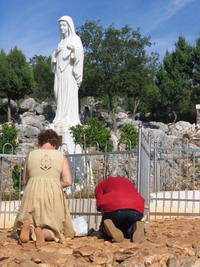
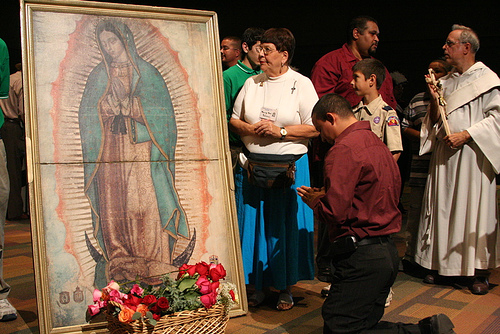
My response would be that, “the bigger issue is, how is it you venerate her in practice. You see it doesn’t matter what you call it, what matters is how it is in reality. Whether you call it worship or veneration, it’s all just semantics. One could say “We don’t eat, we feast”, or “We don’t cry, we weep” or “We don’t scream, we yell”. It’s all semantics, because in reality, when one venerates, one is giving their devotion, their heart, their life to a person who is no longer here on Earth.
For example look at these pictures of people venerating Mary.

Looking at these pictures one realizes that no matter how you put it, this is worship of an idol.
The Word of God in Exodus 20:3-4, says “You shall not make for yourself a carved imageany likeness of anything that is in heaven above, or that is in the earth beneath, or that is in the water under the earth; you shall not bow down to them nor serve them. For I, the LORD your God, am a jealous God, visiting the iniquity of the fathers upon the children to the third and fourth generations of those who hate Me” (NKJV)
Now we true Christians do respect greatly Mary, mother of our Lord Jesus Christ, but not in a way that belongs to God alone. The Glory, worship, honor, and praise belonging only to God, must be given to God alone and to no one else, not even to Mary. Scripture tells us in 1 John 5:21, “Little children, keep yourselves from idols. Amen.” (NKJV)
And in Deuteronomy 4:15-19, “Take careful heed to yourselves, for you saw no form when the LORD spoke to you at Horeb out of the midst of the fire, lest you act corruptly and make for yourselves a carved image in the form of any figure: the likeness of male or female,  the likeness of any animal that [is] on the earth or the likeness of any winged bird that flies in the air, the likeness of anything that creeps on the ground or the likeness of any fish that [is] in the water beneath the earth.  And [take heed], lest you lift your eyes to heaven, and [when] you see the sun, the moon, and the stars, all the host of heaven, you feel driven to worship them and serve them, which the LORD your God has given to all the peoples under the whole heaven as a heritage.”
The command is clear. One must not bow down to idols of any kind including Marian statues.
And even scripture shows us that no one was to worship any person whether human or angel. For example, in Acts 10:24-26, it says “And the following day they entered Caesarea. Now Cornelius was waiting for them, and had called together his relatives and close friends.  As Peter was coming in, Cornelius met him and fell down at his feet and worshiped him.  But Peter lifted him up, saying, "Stand up; I myself am also a man.”
Also in Acts 14:11-15, “Now when the people saw what Paul had done, they raised their voices, saying in the Lycaonian language, "The gods have come down to us in the likeness of men!"  And Barnabas they called Zeus, and Paul, Hermes, because he was the chief speaker.  Then the priest of Zeus, whose temple was in front of their city, brought oxen and garlands to the gates, intending to sacrifice with the multitudes.  But when the apostles Barnabas and Paul heard this, they tore their clothes and ran in among the multitude, crying out and saying, "Men, why are you doing these things? We also are men with the same nature as you, and preach to you that you should turn from these useless things to the living God, who made the heaven, the earth, the sea, and all things that are in them” (NKJV)
And in Revelation 19:9-10, “Then he (the angel) said to me, "Write: 'Blessed [are] those who are called to the marriage supper of the Lamb!' " And he said to me, "These are the true sayings of God."  And I fell at his feet to worship him. But he said to me, "See that you do not do that! I am your fellow servant, and of your brethren who have the testimony of Jesus. Worship God! ...” (NKJV)
Finally, Rev. 22:8-9, “Now I, John, saw and heard these things. And when I heard and saw, I fell down to worship before the feet of the angel who showed me these things.  Then he said to me, "See that you do not do that. For I am your fellow servant, and of your brethren the prophets, and of those who keep the words of this book. Worship God!"  (NKJV)
As the Bible has shown, idolatry is a very serious matter that no one is allowed to worship any other thing or person, except God Himself.

Mediatrix of all Graces
There are two ways in which Catholics call Mary the Mediatrix of all Graces.
The first meaning is that Mary gave birth to Jesus. And since Jesus brings grace to all men, Mary can be said to be Mediatrix of all Graces. True Christians aren’t really opposed to this first meaning, nonetheless we wouldn’t use the term Mediatrix of all Graces.
The second meaning, however, is the one that causes Christians to rightly worry. We read in The HarperCollins Encyclopedia of Catholicism that “through her continual intercessions, Mary was seen as the dispensatrix  (Latin) who distributed and applied the graces of Christ” (“Mediatrix”, ed. Richard P. McBrien, [HarperCollins Publishers, Inc., 1995], p.848).
Vatican II declared as fact that Mary is in Heaven supposedly continuously distributing and applying grace to all mankind till the end of the world. As it states, “This maternity of Mary in the order of grace began with the consent which she gave in faith at the Annunciation and which she sustained without wavering beneath the cross. This maternity will last without interruption until the eternal fulfillment of all the elect. For taken up to heaven, she did not lay aside this saving role, but by her manifold acts of intercession continues to win for us gifts of eternal salvation. By her maternal charity, Mary cares for the brethren of her Son... the Blessed Virgin is invoked by the Church under the titles of Advocate, Auxiliatrix (Helper), Adjutrix (Benefactress), and Mediatrix.” (Lumen Gentium, 62)
Catholic Theologian Ludwigg Ott explains in his book, Fundamentals of Catholic Dogma, that “Since her assumption into Heaven, Mary cooperates in the application of the grace of Redemption of man. She participates in the distribution of grace” (p.213)
For this reason, Pope Pius VII proclaims Mary as the “Dispensatrix of all graces” (Pius VII, Ampliatio privilegiorum ecclesiae B.M. Virginis ab angelo salutatae in cenobio Fratrum Ordinis Servorum B.M.V. Florentiae, A.D., 1806; Armand J. Robichaud, S.M., “Mary, Dispensatrix of all Graces”, Maiology, II, p.429)

Advocate
The Vatican Church also teaches that Catholics should pray to Mary and offer their needs and petitions to her, which she supposedly brings to Jesus as maternal intercessor, and that Mary turns away God’s anger and wrath for people. Catholic feminist theologian Elizabeth Johnson states that, “Mary had a maternal influence over God, that she could turn away Christ’s just anger and obtain mercy for sinners” (“Blessed Virgin Mary”, ed. Richar P. McBrien, The HarperCollins Encyclopedia of Catholicism, p.833)
Saint and Doctor of the Church, Alfonso de’Ligouri states in his book, The Glories of Mary, “Be comforted then, O you who fear’ will I say with Saint Thomas of Villanova; ‘breathe freely and take courage, O wretched sinners; this great Virgin who Is the Mother of your God and Judge, is also the Advocate of the whole human race: fits for this office, for she can do whatever she wills with God, most wise, for she knows all the means of appeasing Him(Alphonsus Liguori, The Glories of Mary, [Tucker Printer Perry’s Place, 1852] p.161)
Pope Pius XI proclaimed “O Blessed Mother, our Queen and Advocate...gather together our prayers and we beseech you (our hearts one with yours) present them before God’s throne...that we may reach the portal of salvation” (Pius XI, papal allocation to French pilgrims present for reading of ‘de tuto’, Canonization of Antida Thouret, 15 August 1933, L’Osservatore Romano, August 15, 1993).

Furthermore, Pope Pius XII declared, “Our Advocate, placed between God and the sinner, takes it upon herself to invoke clemency of the Judge so as to temper His justice” (Pius XII, papal allocation at the Canonization of Louis Marie Grignon de Monfort, 21 July 1947, AAS 39, 408).
Some Catholics believe that the doctrine of Mary as Mediatrix of all graces is not official Catholic doctrine, and thus, they do not have to accept or justify it. However, this doctrine is regarded by the Vatican Church as part of the infallible teaching of the Ordinary Universal Magisterium. In others words, since this doctrine has for a long time been accepted and supported by Popes and by bishops united with them, it is infallible for all Catholics because the Vatican claims the Church could not have been in doctrinal error at such a high level within the Hierarchy for such a long time.
On the subject of this doctrine, Catholic Mariologist Mary Miravalle states in her book, Introduction to Mary, that “in light of the fact that the doctrine of Mary as Mediatrix of all graces has been universally taught in the Church by popes of the last two hundred years and by the bishops in union with them (ordinary Magisterium), and in virtue of this universal teaching of the Church, it has been the opinion of certain modern Mariologists that the doctrine of Mediatrix of all graces already possess the nature of a defined doctrine of faith. In short, the Marian roles of Co-Redemptrix and Mediatrix of all graces represent essential Catholic teaching through the order of the ordinary Magisterium. This charism of the universal teaching authority of all bishops who, when in union with the pope, can exercise the ecclesial element of infallibilty, is disussed in Vatican II’s Constitution on the Church (Lumen Gentium, No. 25).” (p.111)
Some Catholics believe that these teachings are not official and therefore they do not have to believe them or defend them. However, these teachings constitute what is known as infallible teaching of the Ordinary Universal Magisterium. That is because these have been affirmed for so long by Popes and bishops in union with them it is infallible for Catholics since according to Rome the Church could not be in doctrinal error for so long in such a high level.